
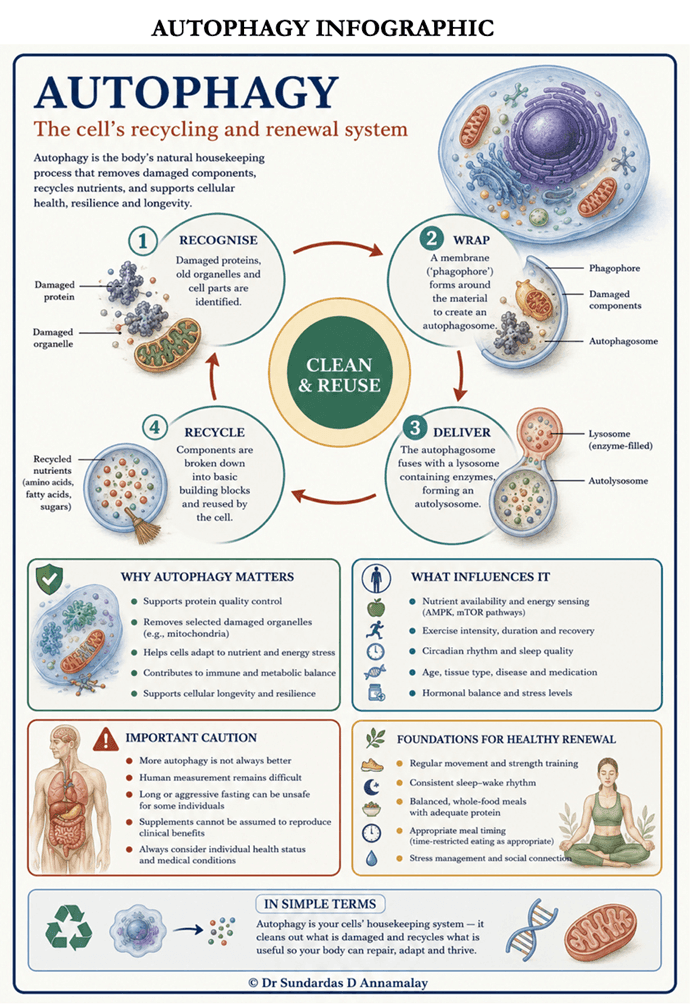
Every cell produces waste. Protein become damaged, organelles wear out, membranes need replacing, and temporary structures must be dismantled when they are no longer required. If this material simply accumulated, the cell would become crowded, inefficient and increasingly vulnerable to stress.
Autophagy is one of the body’s major cellular housekeeping systems. The word means “self-eating,” but that description can sound more destructive than the process really is. Autophagy is an organised form of cellular recycling. It allows a cell to identify selected material, contain it, break it down and reuse useful components.
The best-known form is macroautophagy, usually shortened to autophagy. During this process, a membrane begins to surround unwanted or damaged cellular material. The completed structure is called an autophagosome. It then joins with a lysosome, an acidic compartment containing enzymes that dismantle the contents. Amino acids, fatty acids and other basic materials can then be returned to cellular metabolism.
This is not simply waste disposal. Autophagy helps cells adapt. During temporary nutrient or energy stress, recycling internal material can provide building blocks and fuel. It also supports protein quality control, helps remove selected damaged organelles, contributes to immune defence and assists the cell in adjusting to changing conditions.
Autophagy is therefore part of cellular intelligence. It allows the cell to decide what should be preserved, what should be repaired and what should be taken apart.
There are several forms of autophagy. Macroautophagy uses the autophagosome-lysosome pathway. Microautophagy involves the lysosome directly taking in small portions of cellular material. Chaperone-mediated autophagy uses specialised proteins to recognise and transport selected proteins into the lysosome. These pathways overlap, but they are not identical and they do not respond in exactly the same way in every tissue.
This matters because popular discussions often speak of autophagy as though it were a simple switch. It is not. Autophagy is a dynamic process that is continually adjusted according to tissue type, age, energy status, infection, exercise, sleep, disease and medication. A blood cell, liver cell, neuron and muscle cell may not respond in the same way. https://blog.drsundardas.com/is-your-fatty-liver-shortening-your-life-span/
Autophagy also has a complex relationship with ageing. Impaired autophagy has been associated with loss of protein balance, mitochondrial dysfunction and several age-related diseases. Yet it is too simplistic to say that autophagy always declines uniformly with age. Emerging research shows that changes may be tissue-specific and that activity can differ according to the stage of disease and the type of cellular stress.
The goal of cellular rejuvenation is therefore not to force autophagy to remain permanently high. Excessive or poorly regulated autophagy may also become harmful. Healthy biology depends on appropriate activation, efficient completion and a return to balance.
Fasting is frequently promoted as the fastest way to “turn on” autophagy. Food deprivation can activate nutrient-sensing pathways linked with autophagy in laboratory models, and human studies are beginning to examine this response. However, there is no universal number of fasting hours that guarantees a clinically meaningful level of autophagy in every person. https://www.sundardasnaturopathy.com/digestivewellness
Measuring autophagy in human beings is difficult. Researchers often study specific proteins, gene expression or tissue samples, but these markers do not always reveal whether the entire recycling process has been completed successfully. Increased formation of autophagosomes, for example, can mean that recycling has increased, or that the pathway has become blocked further downstream.
This distinction is called autophagic flux. A healthy recycling system must not only collect cellular cargo. It must also deliver and degrade it. Seeing more recycling bags does not prove that the waste collection service is working if the bags never reach the processing centre.
For this reason, aggressive fasting should not be prescribed solely on the promise of autophagy. Long fasting periods can create dehydration, dizziness, loss of lean tissue, nutritional inadequacy, medication complications and unstable blood glucose. They may be unsuitable during pregnancy, adolescence, frailty, eating-disorder recovery, acute illness, or for people using glucose-lowering medicines unless closely supervised.
Exercise offers another important signal. Physical activity creates a controlled demand for energy and repair. Research indicates that exercise can influence autophagy and lysosomal pathways in skeletal muscle and other tissues. The response depends on intensity, duration, training status, nutrition and recovery. This does not mean that extreme exercise is better. Repeated overload without sufficient recovery can create more damage than adaptation.
Sleep and circadian rhythm may also shape cellular maintenance. The body does not perform every task equally at every hour. Consistent sleep-wake timing supports hormonal, metabolic and immune rhythms that help organise repair. Chronic sleep disruption can impair the wider environment in which autophagy functions.
Nutrition remains important even when discussing recycling. Autophagy does not remove the need for adequate protein, essential fats, vitamins, minerals and plant compounds. The body requires raw materials to rebuild after cellular components have been dismantled. A repeated cycle of severe restriction without nourishment is not rejuvenation.
Commercial products may claim to activate autophagy through compounds such as spermidine, resveratrol, berberine or other ingredients. Some have interesting laboratory or early clinical research, but evidence differs greatly by compound, dose and health condition. Supplements may interact with medication and cannot be assumed to reproduce the effects seen in cells, animals or controlled research settings.
A responsible Cellular Rejuvenation Program begins with the person rather than the pathway. It considers metabolic health, muscle mass, nutritional status, sleep, stress physiology, digestive function, medical history and current treatment. Meal timing, exercise and recovery are then adjusted to support health rather than to chase a biomarker.
Autophagy teaches an important principle: renewal requires both removal and rebuilding. The body must be able to let go of damaged material, but it must also have enough energy and nourishment to create what comes next.
Cellular rejuvenation is not achieved by constant deprivation. It is supported by a rhythm of appropriate challenge, efficient repair, sufficient nourishment and restorative recovery.
A practical starting point
- Use regular physical activity as a controlled stimulus, combining aerobic exercise, strength training and mobility at a level suitable for your health.
- Protect sleep and maintain a consistent daily rhythm so cellular repair is supported by stable metabolic and hormonal timing.
- Avoid continuous grazing when it is not medically necessary, while ensuring meals remain nutritionally complete and appropriate for your energy needs.
- Do not undertake prolonged fasting without professional guidance if you have diabetes, take medication, are pregnant, are underweight, are frail, or have a history of disordered eating.
- Treat “autophagy-activating” supplement claims cautiously. Laboratory evidence is not the same as proven clinical benefit.
Medical note: This article is educational and is not a diagnosis or a substitute for individual medical care. Fasting, dietary restriction and supplements should be assessed in relation to medical history, medications and nutritional status.
Visit the Cellular Rejuvenation Program blog for related articles and practical health education.
Click HERE to review your health patterns and identify practical priorities through a Health and Wellness Assessment: Health and Wellness Assessment
We are here for you at Sundardas Naturopathic Clinic.
Book a private consultation today and take control of your own health. Email admin@naturaltherapies.com to make an appointment, or call +65 6323 6652. Consultations are also available via Zoom for online coaching clients.
Yours in Health,

Prof Sundardas D Annamalay