
Many people know they are upset, stressed, or overwhelmed, but cannot identify exactly what they are feeling. The emotional experience is real, yet the language available to describe it remains broad and imprecise.
When every difficult emotion is labelled simply as “bad,” “angry,” or “stressed,” the nervous system receives very little guidance about what is actually happening. Fear asks for safety. Grief asks for space and mourning. Shame asks for compassionate reality-testing. Disappointment asks for adjustment. Resentment often points toward an ignored boundary. Different emotions carry different information, even when they feel equally uncomfortable. https://www.sundardasnaturopathy.com/emotional-healing
Emotional granularity is the ability to recognise and distinguish between closely related emotional states. It means moving from “I feel terrible” to “I feel disappointed, exposed, and uncertain about what happens next.” This precision is not a matter of sounding sophisticated. It can change how a person understands the situation and which response becomes possible.
Trauma can reduce emotional granularity. In an unsafe childhood, there may have been little room to explore feelings slowly. A child may have needed to react quickly, stay quiet, please an adult, or disconnect from the body. Emotions then become organised around survival categories: safe or unsafe, accepted or rejected, calm or overwhelmed. The finer distinctions are never fully learned—or they become inaccessible under stress. https://www.yourmindstrategy.com/LIVE/events/success-permission/
Some families also discourage emotional language. Sadness may be called weakness. Anger may be punished. Fear may be mocked. Shame may be used as discipline. The child learns not only to suppress feelings, but to mistrust the information they carry. In adulthood, this can appear as emotional numbness, sudden outbursts, chronic tension, indecision, or difficulty explaining needs.
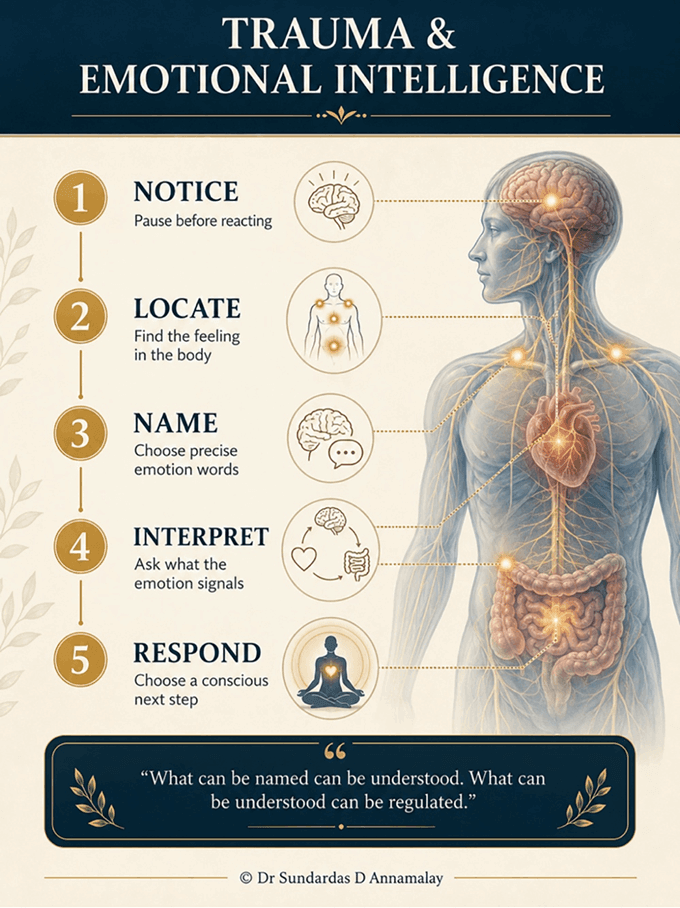
Naming an emotion creates a pause between sensation and action. Instead of becoming the emotion, the person begins to observe it. “I am anxious” becomes “I notice apprehension because the outcome is uncertain.” That shift can support reflective thinking, reduce impulsive behaviour, and make it easier to choose a response rather than repeat an old survival pattern.
Emotional intelligence begins with this internal accuracy. We cannot regulate what we cannot recognise. We cannot communicate what we cannot name. We cannot set an appropriate boundary when irritation, fear, guilt, and resentment are blended into one confusing state.
The body often provides the first clues. Tightness in the throat may accompany inhibited sadness. Heat in the face may accompany embarrassment or anger. A heavy chest may accompany grief. Restlessness may signal apprehension, excitement, or frustration. The goal is not to assign a rigid meaning to every sensation, but to become curious about the relationship between body, context, memory, and emotion.
A useful practice is to ask four questions: What happened? What am I feeling in my body? Which emotion words fit most closely? What does this emotion appear to need from me? The answer may be rest, reassurance, information, grief, expression, distance, repair, or a clear limit.
It is also helpful to use more than one word. Human emotions are rarely pure. A person can feel relieved and sad, proud and frightened, loving and resentful. Mixed emotions do not mean confusion or inconsistency. They often reflect the complexity of real life.
Greater emotional granularity does not eliminate pain. It makes pain more workable. A vague internal storm becomes a set of experiences that can be understood, communicated, and responded to with greater wisdom. https://www.sundardasnaturopathy.com/neuroplasticity
Healing sometimes begins with a more accurate sentence: “I am not simply angry. I feel dismissed, powerless, and afraid that my needs will not matter.” Once the experience is named, the person can begin to decide what belongs to the present, what belongs to the past, and what action would restore dignity and safety.
The more precisely you can recognise your emotional world, the less likely you are to be ruled by unnamed reactions. Emotional language does not weaken feeling. It gives feeling a pathway toward regulation, meaning, and choice.
Reflective Practice
Pause and identify one recent situation in which your reaction felt stronger than the immediate event. Name the body sensation, the emotion, the older belief that may have been activated, and one response that would preserve both self-respect and connection.
Click HERE to review your health patterns and identify practical priorities through a Health and Wellness Assessment: Health and Wellness Assessment
We are here for you at Sundardas Naturopathic Clinic.
Yours in Health,

Prof Sundardas D Annamalay
Book a private consultation today and take control of your health. Email admin@naturaltherapies.com or call +65 6323 6652. Consultations are also available via Zoom for online coaching clients.
Selected scientific references
Ogrodnik, M., et al. (2024). Guidelines for minimal information on cellular senescence experimentation in vivo.
Cell.
Ajoolabady, A., et al. (2025). Hallmarks of cellular senescence: biology, mechanisms and implications.
Experimental & Molecular Medicine.
Lelarge, V., et al. (2024). Senolytics: from pharmacological inhibitors to immunotherapies. npj Aging.
Kuehnemann, C., et al. (2023). Senescent cells at the crossroads of aging, disease, and tissue homeostasis.
Journal of Clinical Investigation.
World Health Organization. (2025). Ageing and health.