
Manual Medicine and Whole-Person Health
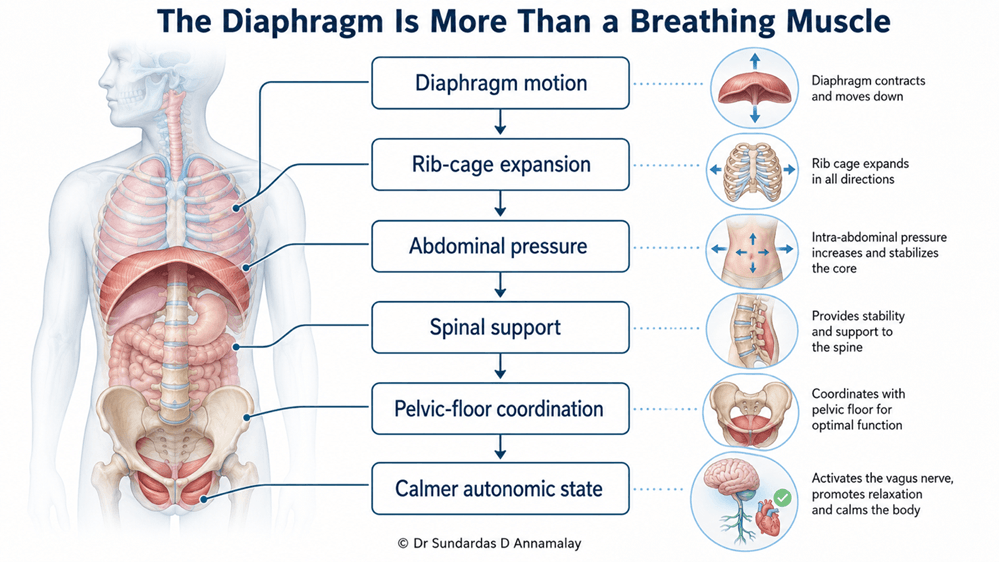
Most people think of the diaphragm only when they are told to “take a deep breath.” Yet this dome-shaped muscle is involved in far more than moving air. It contributes to spinal stability, rib movement, abdominal pressure, circulation and the rhythmic relationship between the chest, abdomen and pelvic floor.
The diaphragm separates the chest from the abdomen. During inhalation it descends, allowing the lungs to expand. During exhalation it relaxes and rises. This movement changes pressure in both cavities and works with the abdominal wall, deep spinal muscles and pelvic floor.
Because breathing and posture share the same structures, the body must constantly negotiate between ventilation and stability. When a person is under stress, in pain or working in a sustained position, breathing may become rapid, shallow and upper-chest dominant. Neck and shoulder muscles then assist more than necessary, while the lower ribs and abdomen move less.
This pattern does not automatically cause back pain, but it can become part of a broader problem. If the diaphragm and abdominal wall are poorly coordinated, the trunk may rely on excessive bracing or superficial muscle tension. Some people hold their breath during lifting, concentration or emotional strain. Others keep the abdomen rigid throughout the day. Both strategies may reduce movement variability and increase fatigue.
“The goal is not to force the body into a perfect shape, but to restore safe and adaptable movement.”
Research on chronic low-back pain suggests that breathing exercises can reduce pain and disability for some patients, particularly when integrated with core-stability and movement programmes. The evidence does not support breathing as a universal cure. It supports the diaphragm as one modifiable part of a larger rehabilitation plan. https://www.sundardasnaturopathy.com/painfree
The diaphragm is also mechanically connected to the lower ribs and lumbar region. Restricted rib motion, thoracic stiffness or persistent abdominal guarding can change the sensation of breathing. A person may describe an inability to “get a full breath,” even when lung tests are normal. This sensation still deserves medical evaluation, especially when it is new or associated with chest pain, fainting or significant shortness of breath.
Digestive symptoms are sometimes discussed in relation to diaphragmatic movement because breathing changes abdominal pressure and gently mobilises the organs. Slow diaphragmatic breathing may support relaxation and may reduce stress-related digestive discomfort in some people. However, persistent reflux, abdominal pain, unexplained weight loss, bleeding or swallowing difficulty requires medical assessment rather than manual treatment alone. https://www.sundardasnaturopathy.com/neuroplasticity
The autonomic nervous system is another important link. Slow, comfortable breathing can reduce arousal and may improve parasympathetic influence. The effect is not mystical; breathing is one of the few bodily functions that is both automatic and voluntarily adjustable. By changing respiratory rate and depth, a person can send the nervous system information that the immediate environment may be safe enough to settle. https://www.sundardasnaturopathy.com/emotional-healing
“The goal is not to force the body into a perfect shape, but to restore safe and adaptable movement.”
In manual medicine, assessment may include rib-cage expansion, thoracic mobility, abdominal wall tension, posture and the coordination of breathing with movement. Treatment may involve gentle work to the ribs, thoracic spine, upper abdomen and related muscles. The pressure should be respectful and adapted to the patient, particularly after surgery, during pregnancy or when abdominal symptoms are present.
A simple starting practice is to breathe quietly through the nose, allowing the lower ribs to widen without forcing the abdomen outward. The exhalation can be slightly longer than the inhalation. The aim is not to take the biggest possible breath, which may create dizziness or tension. The aim is smooth, low-effort breathing.
Breathing should then be integrated into function. Can you exhale during the effort of standing from a chair? Can you continue breathing while lifting a light object? Can the ribs move while the spine remains comfortably supported? These practical questions matter more than performing isolated breathing drills perfectly.
The diaphragm is not a hidden switch that fixes the whole body. It is a central participant in a coordinated system. When breathing, posture, movement and nervous-system regulation begin to work together, many patients report that their body feels less defended and more adaptable.
A Practical Manual-Medicine Approach
|
Assessment |
Possible response |
|
Clarify symptom pattern and red flags |
Refer for medical investigation when indicated |
|
Observe movement, breathing and load distribution |
Identify modifiable patterns rather than a single “fault” |
|
Use gentle, consent-based hands-on care |
Reduce guarding and create a window for movement |
|
Add graded movement and self-management |
Build capacity beyond the treatment room |
Clinical pathway overview
When to Seek Medical Advice
Manual medicine should complement—not replace—appropriate medical diagnosis. Seek prompt assessment for severe or rapidly worsening symptoms, major trauma, progressive weakness or numbness, loss of bladder or bowel control, fever, unexplained weight loss, chest pain, fainting, persistent vomiting, or any symptom that feels medically urgent.
The Central Message
The body is not a collection of isolated parts. It is an adaptive biological system shaped by tissue health, movement, sensation, stress, recovery and meaning. Effective manual medicine respects that complexity. Hands-on care can create an opportunity for change, but lasting progress usually comes from combining touch with education, movement, recovery and active participation.
Click HERE to review your health patterns and identify practical priorities through a Health and Wellness Assessment: Health and Wellness Assessment
We are here for you at Sundardas Naturopathic Clinic.
Yours in Health,

Prof Sundardas D Annamalay
Book a private consultation today and take control of your health. Email admin@naturaltherapies.com or call +65 6323 6652. Consultations are also available via Zoom for online coaching clients.