
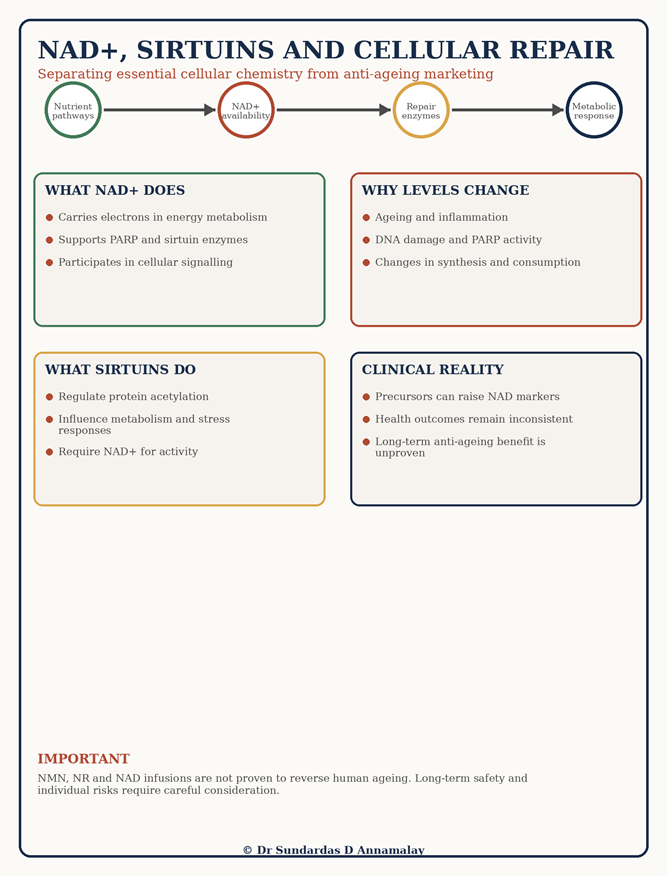
NAD+ has become one of the most heavily marketed molecules in longevity medicine. It is promoted in capsules, powders and intravenous infusions with promises of increased energy, better cognition, DNA repair and reversed ageing. The biology is important. The marketing often moves faster than the evidence.
NAD+ stands for nicotinamide adenine dinucleotide. It is present in every living cell and is essential for energy metabolism. In redox reactions, NAD+ accepts electrons and becomes NADH. NADH can then carry those electrons into pathways that help generate ATP.
NAD+ also serves as a consumed substrate for enzymes. These include sirtuins, poly(ADP-ribose) polymerases or PARPs, and CD38-related enzymes. Through these pathways, NAD+ participates in DNA repair, chromatin regulation, stress responses, immune function and calcium signalling.
Sirtuins are a family of NAD+-dependent enzymes. Humans have seven major sirtuins, located in different cellular compartments. They modify proteins by removing chemical groups and thereby influence metabolism, mitochondrial function, inflammation, circadian rhythm and genome stability.
The phrase “longevity genes” is sometimes used for sirtuins. This is too simple. Sirtuins do not operate as an independent life-extension switch. Their effects differ by tissue, physiological state and disease context. Some actions may be protective, while others can support cell survival in ways that are not always desirable.
NAD+ is made through several routes. The body can synthesise it from tryptophan and can recycle forms of vitamin B3 through salvage pathways. Nicotinamide, nicotinic acid, nicotinamide riboside or NR, and nicotinamide mononucleotide or NMN participate at different points in this metabolism.
Research suggests that NAD+ availability changes with age in several tissues, although measurement is technically difficult and not uniform across the body. Increased consumption by CD38 and PARPs, chronic inflammation, DNA damage and altered synthesis may all contribute.
When DNA damage occurs, PARP enzymes use NAD+ to build signalling chains that organise repair. This is protective, but extensive activation can consume large amounts of NAD+. Sirtuins and PARPs therefore share a dependency on the same metabolic resource.
This has created interest in restoring NAD+ through precursors. Human trials show that NR and NMN can often raise certain NAD-related metabolites in blood. That biochemical effect is real. The unresolved question is whether raising a marker consistently improves meaningful clinical outcomes.
Studies have examined insulin sensitivity, muscle function, vascular health, fatigue, inflammation and cognition. Results are mixed, sample sizes are often small, treatment periods are short and populations differ. A rise in NAD+ does not automatically mean slower ageing or better health. https://www.sundardasnaturopathy.com/programs/gut-brain-digestive-wellness
Intravenous NAD+ is marketed as a direct and superior method. Yet pharmacology, tissue uptake and clinical benefit are not established simply because a molecule enters the bloodstream. Infusions also carry cost, infection, vein and adverse-reaction risks.
Supplement safety requires more than asking whether vitamin B3 is natural. Dose, duration and chemical form matter. High intakes may affect methyl-group metabolism, liver function, glucose regulation or medication response. Long-term safety in people with active or previous cancer remains an area requiring caution because NAD+-dependent pathways also support cell survival and repair.
Exercise is a less glamorous but more established regulator of energy metabolism. It improves mitochondrial function, insulin sensitivity and metabolic flexibility. Depending on the tissue and training state, exercise can influence NAD metabolism and sirtuin activity as part of a broad adaptation.
Sleep and circadian rhythm are also connected to NAD+ and sirtuins. Cellular metabolism changes across the day, and the circadian clock regulates enzymes involved in NAD synthesis. Irregular schedules can disturb this coordination.
A balanced diet supplies tryptophan and vitamin B3 compounds from foods such as meat, fish, legumes, nuts, seeds and whole grains. Deficiency should be corrected, but there is no evidence that eating unlimited niacin produces unlimited cellular repair.
Fasting and calorie restriction influence NAD-dependent pathways in laboratory models. Human application must consider nutritional status, medication, diabetes, frailty, pregnancy and eating-disorder risk. A pathway activated by scarcity is not an instruction for everyone to practise prolonged deprivation.
A responsible Cellular Rejuvenation Program treats NAD+ as one component of a network. Energy production also depends on oxygen delivery, thyroid function, iron status, mitochondrial health, sleep, hormones, movement and psychological load.
Persistent fatigue should never be assumed to represent “low NAD.” It may reflect anaemia, infection, sleep apnoea, depression, medication effects, endocrine disease, cardiac problems or many other causes.
NAD+ biology is scientifically compelling. It may lead to useful therapies. At present, the most accurate message is neither dismissal nor miracle.
Cellular repair requires resources, timing and coordination. Increasing one molecule may help in a defined context, but rejuvenation cannot be reduced to a single infusion or capsule.
A practical starting point
- Support energy metabolism with regular exercise, sleep, adequate food and correction of nutrient deficiencies.
- Do not use NAD-related products as a substitute for investigating persistent fatigue or cognitive change.
- Review cancer history, liver and kidney health, diabetes and medication use before supplementation.
- Be cautious with high-dose, multi-ingredient and intravenous longevity products.
- Judge interventions by meaningful outcomes, not only changes in a laboratory biomarker.
Visit the Cellular Rejuvenation Program blog for related articles and practical health education.
Book a private consultation today and take control of your own health. Email admin@naturaltherapies.com to make an appointment, or call +65 6323 6652. Consultations are also available via Zoom for online coaching clients. We are here for you at the Sundardas Naturopathic Clinic. Health Assessment: https://www.healthandwellnessassessment.com/0
Prof Sundardas D Annamalay
