
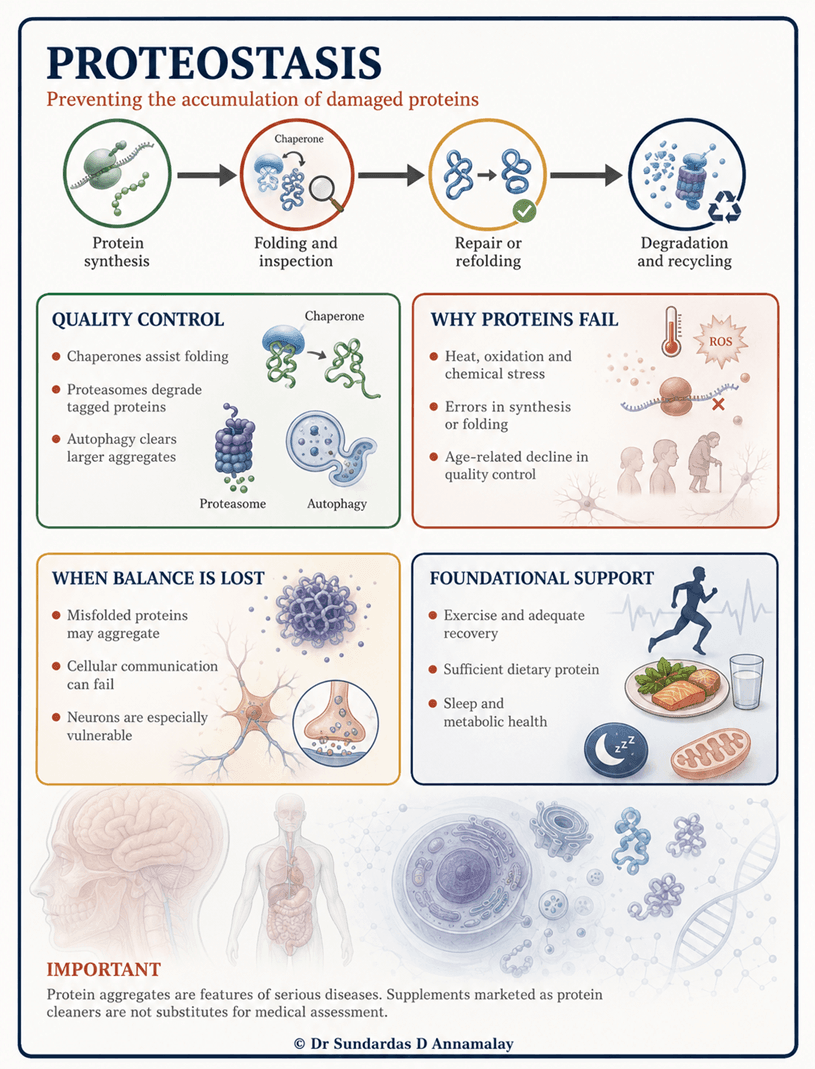
Proteins perform much of the work of life. They act as enzymes, receptors, antibodies, transporters, structural fibres and signalling molecules. Yet a protein can function only when it is produced in the correct amount, folded into the correct shape, transported to the correct location and removed when it becomes damaged.
The coordinated system that maintains this balance is called proteostasis, meaning protein homeostasis.
A protein begins as a chain of amino acids assembled by ribosomes according to genetic instructions. That chain must fold into a precise three-dimensional structure. Shape determines function. A small folding error can expose sticky regions, alter an enzyme’s active site or prevent a protein from reaching its destination.
Cells use molecular chaperones to help proteins fold and to prevent inappropriate interactions. Chaperones do not provide the final structure like a mould. They create conditions in which the protein can reach or recover its functional shape.
Some proteins cannot be rescued. The cell may tag them with ubiquitin and direct them to the proteasome, a molecular complex that unfolds and degrades proteins into smaller components. Larger aggregates and damaged organelles may be handled through autophagy and lysosomal degradation.
Proteostasis therefore includes synthesis, folding, trafficking, quality inspection, repair and disposal. Each component must coordinate with the others. Producing proteins faster is not helpful when folding and clearance systems are overwhelmed.
Heat, oxidative stress, toxins, inflammation and metabolic disturbance can damage proteins. Cells respond through stress pathways such as the heat-shock response and unfolded protein responses in the endoplasmic reticulum and mitochondria. These responses temporarily reduce demand, increase chaperone production and improve clearance.https://blog.drsundardas.com/is-your-fatty-liver-shortening-your-life-span/
Short-term stress responses can be protective. Persistent stress can exceed the capacity of the network. Misfolded proteins may then accumulate and form aggregates. Some aggregates are relatively inert storage structures, while others interfere with membranes, transport, mitochondria or signalling.
Ageing is associated with a gradual decline in several proteostasis mechanisms. Chaperone responses may become less efficient. Proteasomal and autophagic activity may change. Protein synthesis can become less accurate, and damaged proteins may remain longer within tissues.
Long-lived cells, especially neurons, are highly dependent on quality control because they cannot simply dilute damaged material through frequent cell division. This is one reason proteostasis is central to research on Alzheimer’s disease, Parkinson’s disease, amyotrophic lateral sclerosis and other proteinopathies.
However, finding an abnormal protein does not always explain the entire disease. Aggregation may be a cause, a consequence, a protective sequestration response or a combination of these. Effective treatment requires understanding which protein species are toxic, where they arise and how the surrounding cell responds.
Muscle also depends on proteostasis. Resistance exercise creates controlled protein turnover. Training stimulates synthesis, while recovery and nutrition support rebuilding. With ageing, inadequate protein intake, inactivity and illness can contribute to loss of muscle mass and function.
Protein intake should be individualised. Older adults may require attention to protein quantity and distribution, but kidney disease, liver disease, appetite, digestion and total energy intake matter. More protein is not automatically better, and supplements do not replace a balanced diet. https://www.sundardasnaturopathy.com/programs/gut-brain-digestive-wellness
Exercise can activate stress-response and quality-control pathways. Both aerobic and resistance training are associated with healthier cellular adaptation. The benefit comes from repeated cycles of challenge and recovery, not continuous exhaustion.
Sleep supports protein and metabolic maintenance throughout the body and is especially important in the brain. During sleep, neuronal activity, waste clearance and cellular repair follow organised rhythms. Chronic sleep loss can disturb proteostasis and inflammatory regulation.
Plant compounds such as polyphenols are studied for effects on stress-response pathways, autophagy and protein aggregation. Laboratory findings are valuable, but concentration, bioavailability and human outcomes often differ from test-tube experiments. A compound that changes a pathway is not automatically a treatment.
Some anti-ageing messages imply that proteostasis can be restored by “detoxing” protein waste. This language oversimplifies biology. The liver, kidneys, immune system, proteasome and autophagy network perform different forms of processing and clearance. They cannot be replaced by a cleanse.
A responsible Cellular Rejuvenation Program evaluates the pressures placed on protein quality control. These may include poor sleep, chronic inflammation, insulin resistance, nutrient deficiency, inactivity, toxic exposure, medication effects and excessive physiological stress.
The goal is not to prevent every protein from becoming damaged. Damage is unavoidable. Health depends on whether the cell can recognise it, contain it, repair what is repairable and remove what is not.
Proteostasis teaches a practical lesson: resilience is not the absence of error. It is the capacity to correct error before it overwhelms the system.
A practical starting point
- Consume adequate, high-quality protein distributed across meals according to individual needs
- Use regular resistance and aerobic exercise to stimulate healthy protein turnover.
- Protect sleep and recovery, especially during periods of heavy training,illness or stress.
- Manage metabolic disease, inflammation and exposure to tobacco or harmful chemicals.
- Seek assessment for progressive memory, movement,swallowing or muscle symptoms.
Medical note: Neurological and muscle symptoms require timely evaluation. Dietary protein targets should be adjusted in kidney, liver and metabolic disease.
Visit the Cellular Rejuvenation Program blog for related articles and practical health education.
We are here for you at the Sundardas Naturopathic Clinic. Health Assessment: https://www.healthandwellnessassessment.com/0
Prof Sundardas D Annamalay

Book a private consultation today and take control of your own health. Email admin@naturaltherapies.com to make an appointment, or call +65 6323 6652. Consultations are also available via Zoom for online coaching clients.
Selected scientific references
Labbadia, J., & Morimoto, R. I. (2015). The biology of proteostasis in aging and disease. Annual Review of Biochemistry, 84, 435-464.
Meller, A., & Shalgi, R. (2021). The aging proteostasis decline: From nematode to human. Experimental Cell Research, 399(2), 112474.
Tang, J. X., et al. (2023). Editorial: The regulation of proteostasis in aging. Frontiers in Aging, 4, 1198460.
Dubnikov, T., et al. (2017). Protein quality control in health and disease. Cold Spring Harbor Perspectives in Biology, 9(3), a023523.