
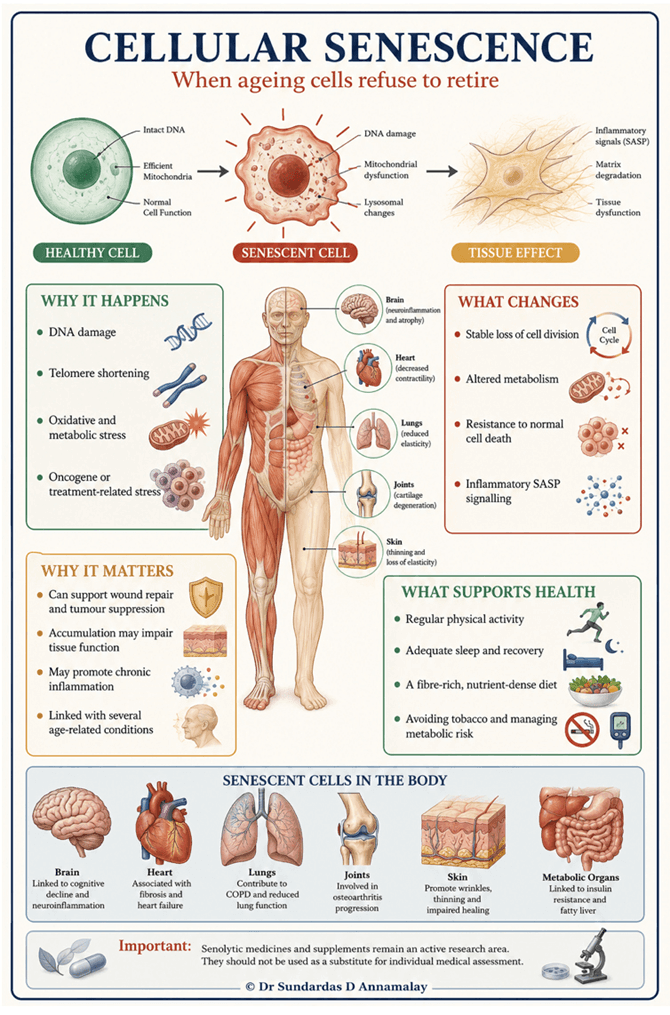
Most people imagine ageing as something that happens to the whole body. Hair changes, skin becomes thinner, joints become less flexible, recovery takes longer, and energy may feel less dependable. Yet ageing also occurs at a microscopic level. Inside tissues, some cells reach a state in which they stop dividing but do not disappear. These are known as senescent cells.
Cellular senescence is not simply cellular death. A senescent cell remains alive and metabolically active, but it enters a stable state of growth arrest. In practical terms, it has withdrawn from the normal cycle of cell division. This response can be protective. When a cell has sustained significant DNA damage or has begun to behave abnormally, stopping division can prevent that damage from being copied and passed to new cells.
This is why senescence should not automatically be described as harmful. In the right place and for the right length of time, it can support embryonic development, wound repair and tumour suppression. The problem arises when senescent cells accumulate, resist clearance and continue influencing the tissue around them.
Senescent cells may release a mixture of inflammatory molecules, growth factors and tissue-remodelling enzymes. Scientists call this pattern the senescence-associated secretory phenotype, or SASP. These signals can help organise short-term repair. But when they persist, they may disturb neighbouring cells, alter immune responses and contribute to an environment of chronic low-grade inflammation.
This is one reason senescent cells are sometimes called “zombie cells.” The phrase is memorable, although biologically imperfect. They are not dead cells brought back to life. They are living cells that no longer perform their former role normally and may continue sending signals long after the original danger has passed.
Cellular senescence can be triggered by many forms of stress. These include repeated cell division, telomere shortening, DNA injury, oxidative stress, mitochondrial dysfunction, oncogene activation, metabolic disturbance, radiation and some medical treatments. The appearance of senescence is therefore not caused by one lifestyle factor and cannot be reduced to a single toxin, food or deficiency.
As we age, the immune system may become less efficient at identifying and removing senescent cells. At the same time, decades of biological stress can create more of them. This combination may allow senescent cells to build up in skin, blood vessels, fat tissue, joints and other organs. Research links this accumulation with features of biological ageing and with several chronic diseases, although the exact role differs by tissue and condition.
The important distinction is between chronological age and biological function. Two people of the same age may have very different levels of inflammation, metabolic health, muscle strength, sleep quality and recovery capacity. Cellular rejuvenation is not about pretending that age does not exist. It is about supporting the conditions that help cells maintain function, repair damage and communicate appropriately for as long as possible.
Can lifestyle remove senescent cells? The evidence is still developing. Exercise is one of the most consistently supported strategies for healthy ageing and appears to influence inflammation, mitochondrial function, glucose regulation, muscle maintenance and immune surveillance. It should not be marketed as a guaranteed “senolytic,” but regular movement can improve the biological environment in which cells age.
Nutrition matters for similar reasons. A varied, fibre-rich and nutrient-dense diet supports metabolic health, the gut microbiome and the body’s antioxidant and repair systems. Stable blood glucose, adequate protein, essential fats and a broad range of plant foods help reduce avoidable metabolic strain. No single superfood has been proven to clear senescent cells from the human body.
https://www.sundardasnaturopathy.com/digestivewellness
Sleep and recovery are equally important. Cellular maintenance is influenced by circadian rhythm, hormonal signalling, immune regulation and energy availability. Chronic sleep restriction may amplify inflammation and metabolic dysfunction, creating conditions that are less favourable for healthy tissue repair.
Reducing tobacco exposure, excessive alcohol intake, sedentary behaviour and uncontrolled metabolic risk is also relevant. These factors can increase oxidative stress, vascular injury and inflammation. Cellular rejuvenation therefore begins less with dramatic anti-ageing claims and more with the consistent reduction of biological burden. https://blog.drsundardas.com/is-your-fatty-liver-shortening-your-life-span/
Scientists are actively studying senolytics, treatments designed to selectively eliminate senescent cells, and senomorphics, approaches intended to reduce harmful secretions without necessarily killing the cells. Early laboratory and animal findings are promising in several areas, but human translation remains complex. Senescent cells are diverse, difficult to identify with one marker, and sometimes beneficial. Removing the wrong cells, at the wrong time, could interfere with healing or other protective functions.
For this reason, commercially promoted “senolytic” supplements should be approached carefully. Evidence from cell cultures or animals does not automatically prove safety or effectiveness in people. Dose, timing, medication interactions, liver and kidney function, cancer history and the person’s wider clinical picture all matter.
A responsible Cellular Rejuvenation Program does not promise immortality or the removal of every ageing cell. Its aim is to assess the biological terrain: sleep, nutrition, inflammation, metabolic regulation, movement, stress physiology, environmental load, digestive function and recovery. The goal is to identify modifiable pressures that may be accelerating decline and to build a personalised plan that supports resilience.
Ageing cells do not always need to be treated as enemies. Senescence is part of the body’s protective intelligence. The therapeutic question is whether the response remains temporary and well regulated, or whether it has become persistent and disruptive.
Healthy ageing is not achieved by fighting the body. It is supported by helping the body complete its cycles of protection, repair, clearance and renewal.
A practical starting point
- Move regularly, combining aerobic activity, strengthworkand mobility at a level appropriate for your health.
- Protect sleep and circadian rhythm by keeping consistent sleep-wake times and reducing late-night stimulation.
- Build meals around minimally processed foods, adequate protein,fibre,colourful plants and healthy fats.
- Address smoking, excessive alcohol use, insulin resistance, chronicinflammationand persistent stress with qualified professional support.
- Avoid self-prescribing experimental anti-ageing compounds or high-dose supplements on the basis of marketing claims.
Medical note: This article is educational and is not a diagnosis or a substitute for individual medical care. Symptoms, medications, cancer history and chronic disease require personalised assessment.
Visit the Cellular Rejuvenation Program blog to explore related articles and practical health education.
Click HERE to review your health patterns and identify practical priorities through a Health and Wellness Assessment: Health and Wellness Assessment
We are here for you at Sundardas Naturopathic Clinic.
Yours in Health,

Prof Sundardas D Annamalay