
Manual Medicine and Whole-Person Health
Pain is often treated as though it belongs only to the place where it is felt. A painful shoulder is assumed to be a shoulder problem. A tight calf is treated as an isolated calf. A stiff lower back is approached as though the rest of the body has little to do with it. Manual medicine invites a broader question: what if the painful area is one part of a larger tension network?
Fascia is the body’s connective-tissue framework. It surrounds and links muscles, bones, nerves, blood vessels and organs, while helping tissues glide over one another. Rather than being an inert wrapping, fascia is richly supplied with sensory receptors and participates in force transmission, body awareness and pain signaling. https://www.sundardasnaturopathy.com/painfree
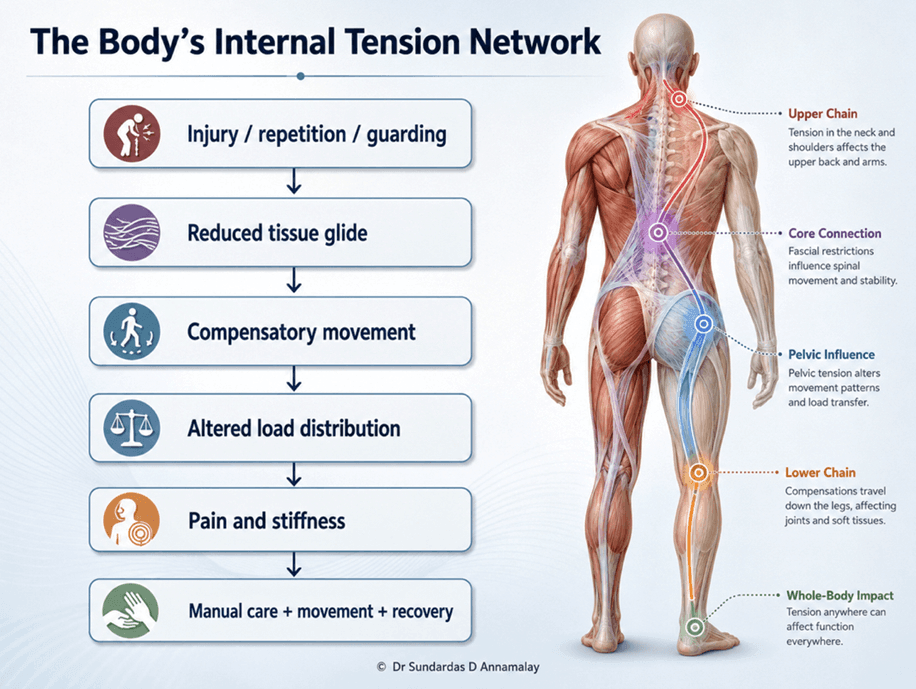
A useful image is a three-dimensional fabric running through the body. When one region becomes less mobile after injury, repetitive loading, surgery, inflammation or prolonged guarding, movement may be redistributed elsewhere. The body usually finds a way to keep functioning, but the substitute strategy may require more effort and may eventually become painful.
This does not mean that every pain is caused by “tight fascia,” nor does it mean that a therapist can permanently reshape the body with a single technique. Fascia is living tissue, and symptoms are influenced by many factors including sleep, stress, inflammation, strength, joint health, nervous-system sensitivity and daily movement. A responsible manual-medicine assessment therefore avoids simplistic explanations.
“The goal is not to force the body into a perfect shape, but to restore safe and adaptable movement.”
One reason fascial problems can feel confusing is that the site of pain may not be the only site that matters. Restricted ankle motion can alter the way force travels through the knee and hip. A guarded rib cage can change shoulder mechanics. A scar across the abdomen may influence trunk rotation and breathing. These relationships are not fixed chains, but they remind us that the body functions as an integrated system.
Posture also needs to be understood dynamically. There is no single perfect posture that must be held all day. Healthy posture is the capacity to move between positions and to tolerate the demands of work, rest and activity. Difficulty arises when the body becomes trapped in a narrow range of strategies: always bracing, always collapsing, always shifting away from one side, or repeatedly avoiding a movement that once hurt.
Manual assessment may include observing gait, breathing, spinal movement, joint range, tissue glide and the way symptoms change when neighbouring regions are supported or moved. The practitioner is not merely searching for a “knot.” The aim is to understand how the person distributes load, where movement is missing, and whether the nervous system regards certain movements as threatening.
Hands-on approaches may include soft-tissue mobilisation, myofascial techniques, articulation, stretching and gentle osteopathic methods. Research suggests that some people experience short-term improvements in pain and mobility, although the evidence varies by condition and technique. The most durable results usually come when manual care is combined with movement, strength, graded exposure and changes to the activities that repeatedly provoke symptoms.
“The goal is not to force the body into a perfect shape, but to restore safe and adaptable movement.”
Hydration is often promoted as a cure for fascial stiffness, but the message should be kept realistic. Adequate fluid intake supports general tissue health, yet persistent pain rarely disappears through water alone. Regular varied movement, sufficient recovery, progressive loading and attention to sleep and stress are usually more important than any single “fascial reset.”
The emotional system can also influence physical tension. Anxiety, vigilance and unresolved threat may increase protective muscle activity and reduce movement variability. This does not make pain imaginary. It means that the body and nervous system are responding together. Gentle touch, breathing and safe movement may help reduce guarding, but care must remain respectful and never imply that the patient caused the pain by thinking incorrectly.
Seek medical assessment when pain follows major trauma, is accompanied by progressive weakness or numbness, causes unexplained weight loss or fever, disturbs bladder or bowel control, or is severe and unremitting. Manual medicine is most useful when it works alongside appropriate diagnosis rather than replacing it.
The goal is not to chase every tight area. It is to help the body regain options. A system with more options can distribute load, adapt to stress and recover more efficiently. In that sense, fascial care is not simply about making tissue softer. It is about restoring comfortable movement, confidence and resilience.
When to Seek Medical Advice
Manual medicine should complement—not replace—appropriate medical diagnosis. Seek prompt assessment for severe or rapidly worsening symptoms, major trauma, progressive weakness or numbness, loss of bladder or bowel control, fever, unexplained weight loss, chest pain, fainting, persistent vomiting, or any symptom that feels medically urgent.
Clinical pathway overview
A Practical Manual-Medicine Approach
|
Assessment |
Possible response |
|
Clarify symptom pattern and red flags |
Refer for medical investigation when indicated |
|
Observe movement, breathing and load distribution |
Identify modifiable patterns rather than a single “fault” |
|
Use gentle, consent-based hands-on care |
Reduce guarding and create a window for movement |
|
Add graded movement and self-management |
Build capacity beyond the treatment room |
The Central Message
The body is not a collection of isolated parts. It is an adaptive biological system shaped by tissue health, movement, sensation, stress, recovery and meaning. Effective manual medicine respects that complexity. Hands-on care can create an opportunity for change, but lasting progress usually comes from combining touch with education, movement, recovery and active participation.
Click here to review your health patterns and identify practical priorities through a Health and Wellness Assessment: Health and Wellness Assessment
We are here for you at Sundardas Naturopathic Clinic.
Yours in Health,

Prof Sundardas D Annamalay
Book a private consultation today and take control of your health. Email admin@naturaltherapies.com or call +65 6323 6652. Consultations are also available via Zoom for online coaching clients.
Selected References
- Langevin HM. Fascia mobility, proprioception, and myofascial pain. Life. 2021.
- Ajimsha MS et al. Effectiveness of myofascial release: systematic review. J Bodyw Mov Ther. 2015.
- Bordoni B et al. Anatomy, Fascia. StatPearls. Updated 2023.