
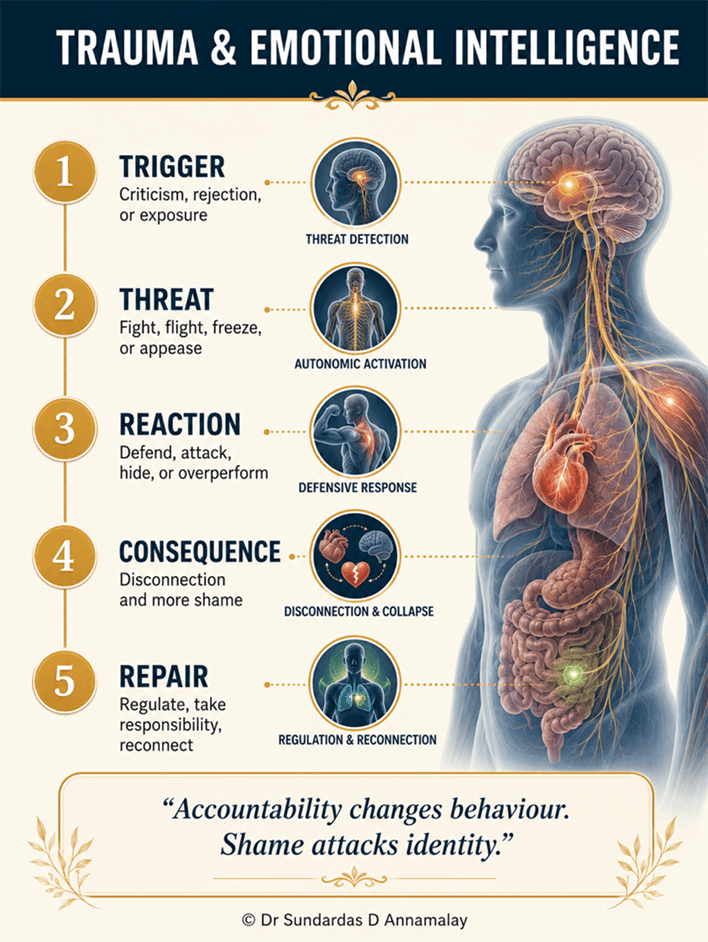
Shame is more than the thought that something went wrong. It is the painful belief that something is wrong with the self.
Healthy guilt says, “I did something that needs correction.” Shame says, “I am defective, unacceptable, or unworthy of belonging.” Guilt can guide repair. Shame often drives hiding, defensiveness, perfectionism, aggression, collapse, or compulsive attempts to prove worth.
Because human beings depend on connection, shame can be experienced by the nervous system as a social threat. A critical look, dismissive tone, public correction, or perceived failure may activate reactions that seem disproportionate to the present event. The body may tense, the mind may go blank, and the person may feel an urgent need to escape, attack, justify, appease, or disappear.
This creates a shame–threat cycle. A person senses criticism or rejection. The nervous system moves into defence. Emotional intelligence narrows. The person reacts through blame, withdrawal, over-explaining, people-pleasing, or self-attack. The reaction then creates more relational difficulty, which is interpreted as further evidence of defectiveness. Shame strengthens the very behaviours that make repair harder.
Trauma often deepens this cycle. Children naturally interpret repeated experiences in personal terms. If care is withdrawn, conflict is frightening, or affection is conditional, the child may not conclude that the adult is dysregulated or limited. The child is more likely to conclude, “I am too much,” “I am not enough,” or “I must earn love.” These conclusions can become part of a personal mythology carried into adulthood. https://www.yourmindstrategy.com/LIVE/events/success-permission/
The cycle may appear as perfectionism. The person tries to become beyond criticism, believing flawless performance will guarantee safety. It may appear as chronic apologising, even when no wrongdoing occurred. It may appear as intolerance of feedback, because feedback is experienced not as information about behaviour but as a verdict on identity.
Shame can also hide beneath anger. Anger restores a temporary sense of power when the person feels exposed or small. This does not excuse harmful behaviour, but it explains why direct confrontation with shame often requires safety, pacing, and accountability rather than humiliation.
Emotional intelligence is hijacked when self-protection becomes more urgent than understanding. In that state, curiosity decreases. Perspective-taking becomes difficult. The person hears accusation where another person may be expressing hurt. They may defend intention while ignoring impact.
Interrupting the cycle begins by separating identity from behaviour. “I made a mistake” is different from “I am a mistake.” A behaviour can be acknowledged, repaired, and changed without turning the entire self into an object of contempt.
A second step is nervous-system regulation. Slowing the breath, feeling the feet, orienting to the room, or requesting a short pause can reduce the intensity of the threat response. Regulation does not remove responsibility. It creates enough internal space to face responsibility without collapse or counterattack.
A third step is compassionate accountability. Self-compassion is not self-exoneration. It is the capacity to remain connected to one’s humanity while telling the truth about harm. This makes genuine apology and behavioural change more possible. https://www.sundardasnaturopathy.com/neuroplasticity
When shame is met with truth, boundaries, and dignity, it can lose its controlling power. The aim is not to become immune to embarrassment or remorse. The aim is to stop using self-rejection as the price of growth.
You are responsible for what you do, but you are more than your worst action, your most painful failure, or the story shame taught you to believe. Healing allows correction without self-annihilation.
Reflective Practice
Pause and identify one recent situation in which your reaction felt stronger than the immediate event. Name the body sensation, the emotion, the older belief that may have been activated, and one response that would preserve both self-respect and connection. https://www.sundardasnaturopathy.com/emotional-healing
Click HERE to review your health patterns and identify practical priorities through a Health and Wellness Assessment: Health and Wellness Assessment
We are here for you at Sundardas Naturopathic Clinic.
Yours in Health,

Prof Sundardas D Annamalay
Book a private consultation today and take control of your health. Email admin@naturaltherapies.com or call +65 6323 6652. Consultations are also available via Zoom for online coaching clients.