
Manual Medicine and Whole-Person Health
A surgical scar may look small on the surface while representing a much larger healing process underneath. Caesarean sections, appendectomies, laparoscopic procedures and other abdominal operations affect layers of skin, fascia, muscle and internal tissue. Most scars heal well, but some continue to influence sensation, movement and comfort long after the wound has closed.
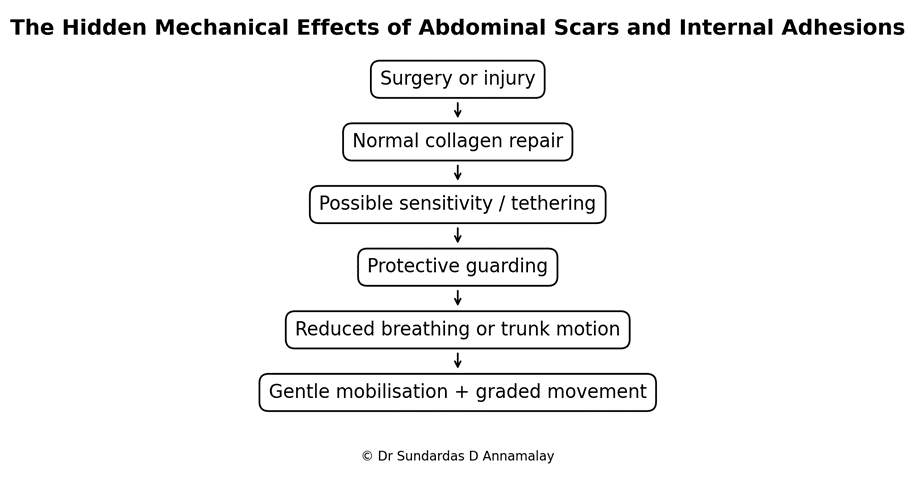
Scar formation is a normal part of healing. Collagen is laid down to repair damaged tissue, and the new tissue gradually remodels. During this process, the scar may feel firm, sensitive, numb, itchy or tethered. These sensations often improve, but the timing varies widely.
An adhesion is a band of scar-like tissue that forms between internal surfaces that would normally move more freely. Adhesions are common after abdominal surgery, yet many cause no symptoms. When symptoms do occur, they may include pulling, restricted trunk movement, pelvic or abdominal discomfort, or—in more serious cases—bowel obstruction.
It is important not to diagnose adhesions from touch alone. Internal adhesions cannot be reliably mapped by simply pressing on the abdomen, and pain after surgery can have many causes. A practitioner should first consider wound healing, infection, hernia, nerve irritation, organ-related problems and other medical explanations.
“The goal is not to force the body into a perfect shape, but to restore safe and adaptable movement.”
Externally, a scar can influence movement through sensitivity and guarding. A person may unconsciously avoid extending the hip, rotating the trunk or allowing the abdomen to expand during breathing. Over time, the avoidance can become habitual even after the tissue is medically healed.
The effects may be noticed far from the scar. A lower abdominal scar can alter the way a person stands up, walks or loads the pelvis. A laparoscopic scar near the ribs may contribute to protective upper-abdominal tension. These are possible relationships, not guaranteed causes, and they should be tested by observing whether movement changes when the scar region is gently supported. https://www.sundardasnaturopathy.com/programs/pain-posture-somatic-osteopathy
Manual scar therapy can include light touch, skin rolling, gentle mobilisation and graded sensory exposure. The intensity should match the stage of healing. Fresh wounds, open skin, infection, unexplained swelling and acute inflammation are not appropriate for routine scar mobilisation.
Evidence for manual scar treatment is still developing. Reviews report improvements in pain, pliability, itching, movement or patient-rated scar quality in some studies, but techniques and outcomes vary. Claims that massage can “break up” all internal adhesions should be treated cautiously. The realistic goals are to improve comfort, local mobility, sensory tolerance and movement confidence.
“The goal is not to force the body into a perfect shape, but to restore safe and adaptable movement.”
Breathing is often useful because the abdominal wall and lower ribs move rhythmically with the diaphragm. A patient may begin by placing a hand near—not directly on—a sensitive scar and practising relaxed breathing. Later, gentle trunk rotation, hip extension and functional movement can be reintroduced.
A mother came in after her third caesarean surgery. Weeks after the surgery she still looked like she was three months pregnant. The surgery had left scarring, restrictions and adhesions. Three sessions of visceral manipulation sorted the matter out. The grateful mother retained the figure she had pre-pregnancy.
Psychological safety matters. Surgical scars may be connected with childbirth, emergency procedures, cancer treatment, pain or fear. Consent should be explicit, and the patient should remain in control of pressure, location and duration. Hands-on work should never be imposed on a scar simply because the practitioner believes it is mechanically important.
Urgent assessment is required for severe or escalating abdominal pain, persistent vomiting, abdominal distension, inability to pass stool or gas, fever, wound discharge, new bleeding or a painful bulge that could indicate a hernia. These are not symptoms to treat with massage.
A healed scar is not defective tissue. It is evidence that the body repaired itself. Manual medicine can support that repair by helping the person regain comfortable touch, breathing and movement—while respecting the limits of what hands-on care can and cannot change.
Clinical pathway overview
A Practical Manual-Medicine Approach
| Assessment | Possible response |
| Clarify symptom pattern and red flags | Refer for medical investigation when indicated |
| Observe movement, breathing and load distribution | Identify modifiable patterns rather than a single “fault” |
| Use gentle, consent-based hands-on care | Reduce guarding and create a window for movement |
| Add graded movement and self-management | Build capacity beyond the treatment room |
When to Seek Medical Advice
Manual medicine should complement—not replace—appropriate medical diagnosis. Seek prompt assessment for severe or rapidly worsening symptoms, major trauma, progressive weakness or numbness, loss of bladder or bowel control, fever, unexplained weight loss, chest pain, fainting, persistent vomiting, or any symptom that feels medically urgent.
The Central Message
The body is not a collection of isolated parts. It is an adaptive biological system shaped by tissue health, movement, sensation, stress, recovery and meaning. Effective manual medicine respects that complexity. Hands-on care can create an opportunity for change, but lasting progress usually comes from combining touch with education, movement, recovery and active participation.
Click here to review your health patterns and identify practical priorities through a Health and Wellness Assessment: Health and Wellness Assessment
We are here for you at the Sundardas Naturopathic Clinic.

Prof Sundardas D Annamalay
Book a private consultation today and take control of your health. Email admin@naturaltherapies.com or call +65 6323 6652. Consultations are also available via Zoom for online coaching clients.