
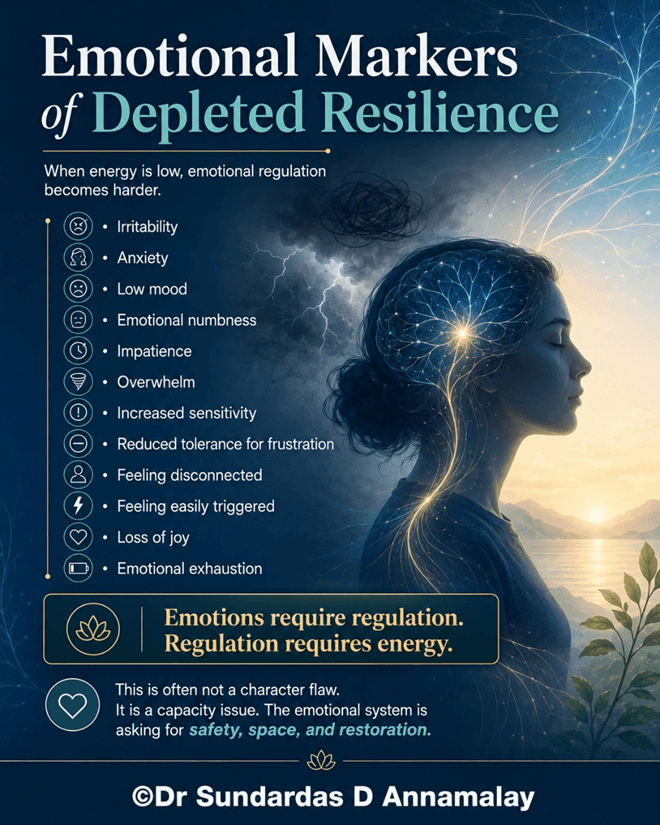
When energy is low, emotional regulation becomes harder.
This is one of the clearest signs that resilience is depleted. You may still be functioning, meeting responsibilities, communicating with others, and getting through the day, but internally your emotional system may feel strained. Things that would normally feel manageable can start to feel overwhelming. Small frustrations may create strong reactions. Conversations may feel heavier than they should. Ordinary demands may feel like too much.
Emotional markers of depleted resilience may include irritability, anxiety, low mood, emotional numbness, impatience, overwhelm, increased sensitivity, reduced tolerance for frustration, feeling disconnected, feeling easily triggered, loss of joy, and emotional exhaustion.
These experiences are not random. They are often signals from the nervous system. Emotions require regulation. Regulation requires energy. https://blog.drsundardas.com/why-people-experience-emotional-breakdowns/
When the nervous system is well-resourced, you have more capacity to feel emotions without being controlled by them. You can notice anger without immediately reacting. You can feel anxiety without being completely consumed by it. You can pause before speaking. You can respond with perspective rather than impulse. You can recover after conflict, disappointment, pressure, or uncertainty.
But when resilience is depleted, that space between feeling and reacting becomes smaller.
Emotions may feel faster, louder, and harder to contain. Irritation may rise quickly. Anxiety may become more persistent. Sadness may feel heavier. You may feel numb rather than emotional because the system has moved into self-protection. You may withdraw, shut down, snap, cry more easily, or feel emotionally unavailable even toward people you care about.
This does not mean you are weak. It does not mean you are dramatic, difficult, unstable, or failing.
It often means your capacity is reduced.
The emotional system is deeply connected to physical energy, sleep, stress load, safety, and recovery. When the body is tired or the nervous system has been under pressure for too long, emotional regulation becomes more expensive. The system has fewer resources available to manage stimulation, disappointment, conflict, uncertainty, or relational demands.
This is why something small can feel enormous when you are depleted.
A message can feel threatening. A delay can feel unbearable. A question can feel like criticism. A normal responsibility can feel like another weight being added to an already overloaded system.
The goal is not to judge the emotion. The goal is to understand the signal.
Depleted resilience often asks for safety, space, and restoration. It may ask for rest, reduced stimulation, clearer boundaries, nourishment, emotional support, or time away from demands. It may ask you to slow down before you push harder.
Emotional exhaustion is not simply an attitude problem. It is often the nervous system saying: “I do not have enough capacity to keep regulating at this level.”
Recognizing this early matters.
When you notice irritability, numbness, overwhelm, or emotional reactivity increasing, it may be a cue to restore rather than criticize yourself. The emotional system is not trying to sabotage you. It is trying to protect you. https://www.sundardasnaturopathy.com/emotional-healing
Resilience returns when capacity is rebuilt.
Click here to review your life choices and find out what you can do to reduce the load Health and Wellness Assessment.
We are here for you at the Sundardas Naturopathic Clinic.
Prof Sundardas D Annamalay.

Book a private consultation today and take control of your own health. Simply email us at??admin@naturaltherapies.com to make?an appointment.
Or call +65 63236652. We are pleased to offer consultations via Zoom for online coaching clients.