
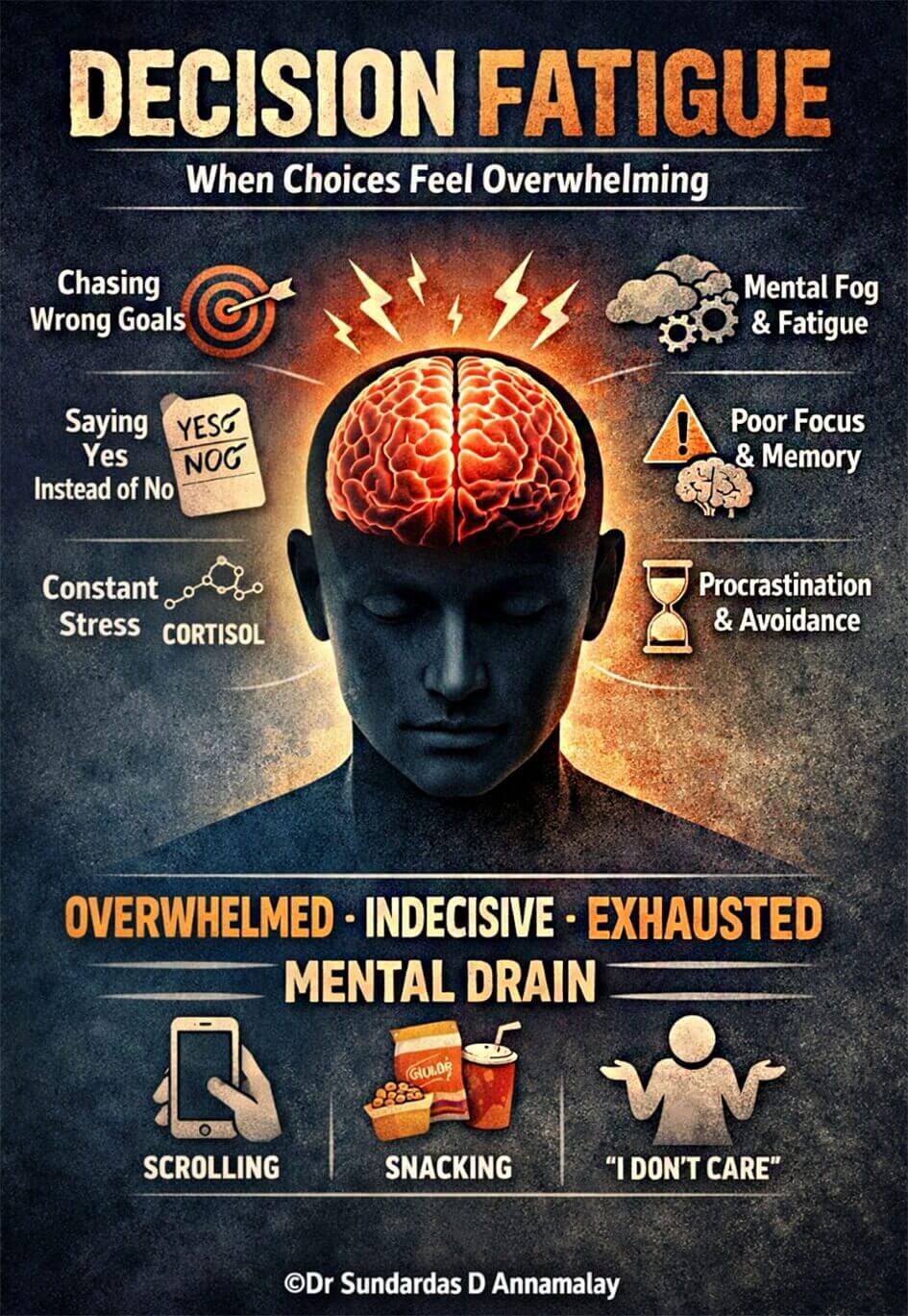
Have you noticed how even small decisions can feel weirdly heavy lately? What to eat. Whether to reply now or later. Which task to start first. Things that used to take seconds now take minutes. And even after you decide, you second-guess yourself.
That mental drag isn’t laziness. And it’s not just “getting older.” It’s often something called decision fatigue.
Your brain is a finite resource system. Every decision you make draws from the same cognitive fuel tank—prioritizing, evaluating trade- offs, predicting outcomes, managing emotions. When that tank runs low, the quality of your decisions drops. You procrastinate. You default to the easiest option. Or you avoid deciding at all.
But here’s the part most people miss.
Decision fatigue isn’t only about quantity of decisions. It’s about misalignment.
When you’re internally misaligned—saying yes when you want to say no, chasing goals that don’t actually fit, operating from pressure instead of clarity—your brain stays in low-grade stress mode. That subtle tension costs more energy than you realize.
https://www.sundardasnaturopathy.com/emotional-healing
Physiologically, the stress response doesn’t need a crisis to activate. Persistent internal conflict is enough. Cortisol rises. Not dramatically. Just enough to keep your system slightly on edge. The prefrontal cortex—the part responsible for reasoning, impulse control, and long-term planning—has to work harder. Meanwhile, emotional centers become more reactive.
The result is predictable:
- Focus drops
- Memory slips
- Simple tasks feel complex
- Choices feel heavier than they should
- You’re not incapable
- You’re taxed
When you repeatedly override your internal signals, your brain must constantly reconcile the gap between what you feel and what you’re doing. That reconciliation requires effort. It’s like running background software that never fully shuts off. You don’t notice it directly, but it drains processing power.
Over time, your system looks for relief. And relief often shows up as avoidance. Scrolling instead of deciding. Snacking instead of choosing. Saying “I don’t care” when you actually do. It’s not apathy—it’s conservation.
https://www.yourmindstrategy.com/LIVE/events/success-permission/
There’s also a compounding effect. When you make decisions from pressure rather than clarity, you tend to create outcomes that require more decisions later. More fixes. More adjustments. More mental load. The cycle reinforces itself.
The solution isn’t to become more disciplined.
It’s to reduce unnecessary internal friction.
That means noticing where you’re operating from obligation rather than alignment. Where you’re pursuing something because it sounds right, not because it feels right. Where you’re keeping options open out of fear rather than intention.
Clarity simplifies. Alignment conserves energy.
When your actions match your values, decisions require less debate. When your commitments reflect your priorities, there’s less negotiation in your head. Your nervous system relaxes. Cortisol lowers. Cognitive bandwidth returns.
https://www.sundardasnaturopathy.com/neuroplasticity
And suddenly, choosing what to eat or what to work on doesn’t feel like moving through mud.
If small decisions feel unusually heavy, don’t assume you need more willpower.
Assume you need less friction.
Your brain isn’t broken. It’s overloaded.
If you need help you can click HERE to review your lifestyle choices and find out what you can do to improve it.
Health and Wellness Assessment
We are here for you at Sundardas Naturopathic Clinic.
Yours in Health,

Prof Sundardas D Annamalay