
Manual Medicine and Whole-Person Health
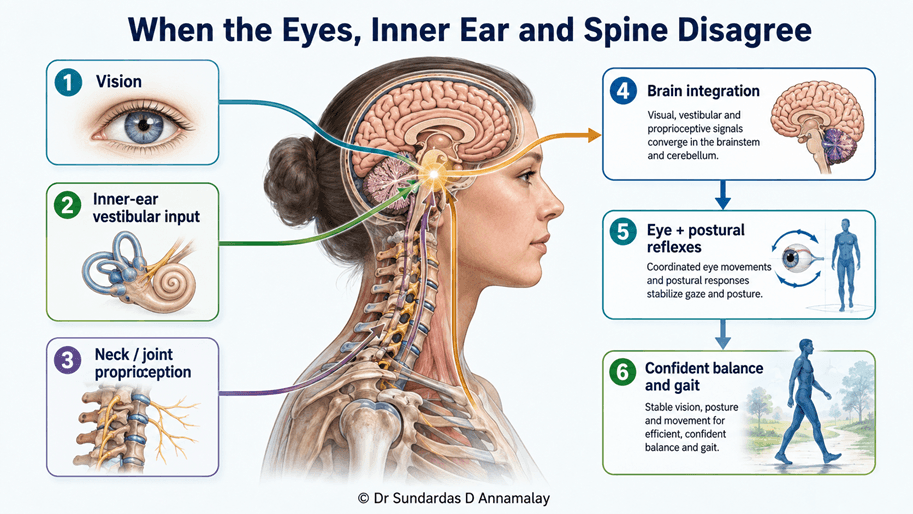
Balance is not produced by one organ. It is an ongoing conversation between the eyes, the inner ear, the sensory receptors in the joints and muscles, and the brain regions that compare all of this information. Most of the time the conversation is seamless. When the signals conflict, a person may feel dizzy, unsteady or strangely disconnected from the ground.
The visual system tells the brain where the body is in relation to the environment. The vestibular system in the inner ear detects head movement and gravity. Proprioception provides information from muscles, joints, skin and the soles of the feet. The brain combines these inputs and produces rapid adjustments in eye movement, posture and muscle tone.
No single system works in isolation. In a dark room, vision contributes less, so the brain relies more on vestibular and proprioceptive input. On an unstable surface, information from the feet becomes less reliable, so vision and the inner ear become more important. Healthy balance depends on the ability to reweight these signals.
Problems arise when one input is inaccurate, delayed or over-relied upon. A person may become visually dependent and feel worse in supermarkets, crowds or scrolling environments. After an ankle injury, proprioceptive accuracy may be reduced. Inner-ear disorders may create vertigo or a sense that the environment is moving.
“The goal is not to force the body into a perfect shape, but to restore safe and adaptable movement.”
The neck also contributes important positional information. Dense proprioceptive receptors in the upper cervical region help coordinate the head, eyes and trunk. In some patients with neck pain, altered cervical input may contribute to dizziness through a sensory mismatch with visual and vestibular signals. This diagnosis is considered only after other causes have been evaluated. https://www.sundardasnaturopathy.com/programs/pain-posture-somatic-osteopathy
Dizziness is a symptom, not a diagnosis. It may describe spinning, light-headedness, imbalance, faintness, visual motion sensitivity or a floating sensation. Because the causes range from benign to urgent, assessment should include timing, triggers, hearing changes, neurological symptoms, cardiovascular factors, medication and recent illness or injury.
Immediate medical attention is needed for sudden severe dizziness with facial weakness, speech difficulty, double vision, new limb weakness, inability to walk, severe headache, chest pain or fainting. These can indicate stroke or other serious conditions.
A functional neurological and manual-medicine examination may assess eye movements, head-position tolerance, balance with different sensory conditions, gait, neck movement and joint-position sense. The purpose is not to manipulate every dizzy patient. It is to identify which system appears overloaded or unreliable and whether referral is required.
“The goal is not to force the body into a perfect shape, but to restore safe and adaptable movement.”
Treatment may combine vestibular rehabilitation, gaze-stability exercises, balance training, foot and ankle rehabilitation, neck treatment and graded exposure to visually complex environments. Manual therapy can reduce pain and improve neck mobility in selected patients, but it should not replace vestibular or neurological assessment. https://www.sundardasnaturopathy.com/programs/neuroplasticity-cognitive-wellness
Exercises need to be dosed carefully. Mild, short-lived symptom provocation may be part of retraining, but severe or prolonged worsening is not the goal. The nervous system learns through repeated, manageable experiences—not through overwhelming exposure. https://www.sundardasnaturopathy.com/programs/emotional-healing-trauma-recovery
Footwear, vision correction, sleep, hydration, blood pressure and medication can all influence balance. In older adults, strength and reaction time are especially important. A comprehensive plan may therefore look beyond the neck and inner ear to the whole person and their environment.
Balance improves when the brain can trust its incoming information and respond efficiently. The aim is not simply to stand still without swaying. Normal balance includes small corrections. The deeper goal is adaptability: being able to move through different surfaces, lighting conditions and environments with confidence.
Prof Sundardas D Annamalay
