
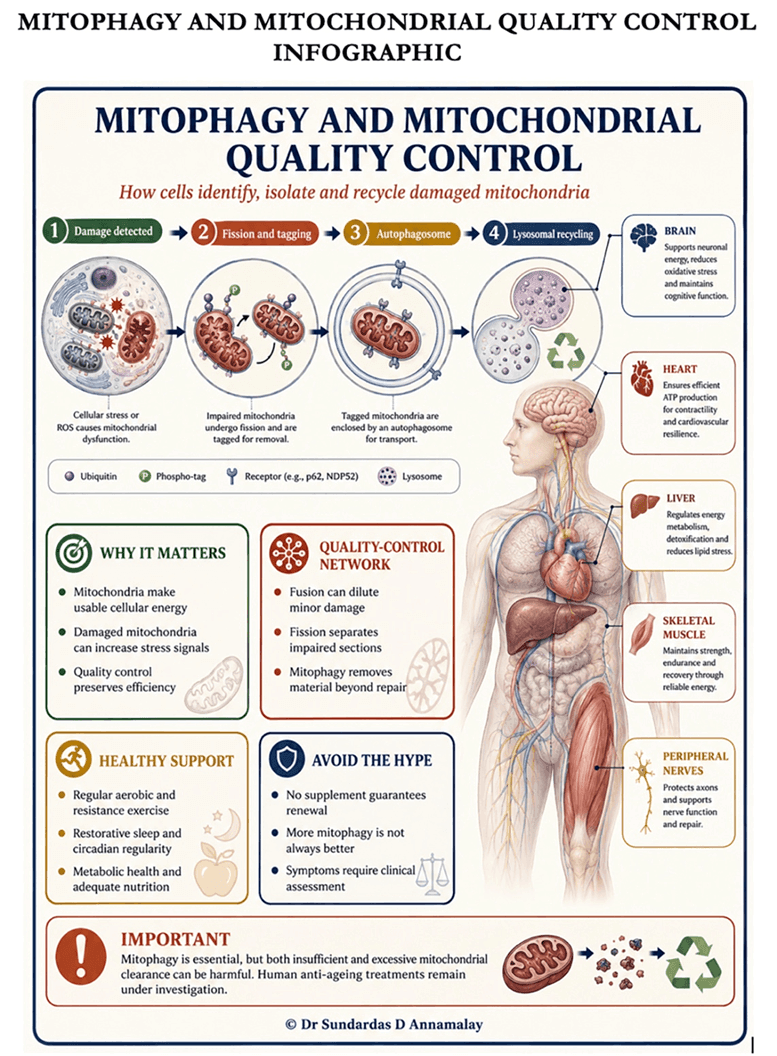
Mitochondria are often introduced as the “powerhouses” of the cell. That description is useful, but incomplete. These organelles do far more than generate adenosine triphosphate, or ATP. They help regulate calcium, cellular signalling, immunity, heat production, stress responses and programmed cell death. Because their work is demanding, mitochondria are also vulnerable to damage.
A healthy cell does not keep every mitochondrion indefinitely. It continually inspects, repairs, rearranges and, when necessary, removes them. This coordinated process is called mitochondrial quality control. Mitophagy is one of its most important components.
Mitophagy means the selective removal of mitochondria through the autophagy-lysosome system. When a mitochondrion becomes severely impaired, the cell can isolate it, enclose it within a membrane structure called an autophagosome and deliver it to a lysosome. The lysosome then breaks down the damaged material so that useful components can be recycled.
This process protects the cell from more than an inefficient energy generator. Dysfunctional mitochondria may leak reactive oxygen species, release mitochondrial DNA or send danger signals that activate inflammation. In the correct context, these signals help the body respond to injury. When they become persistent, they may contribute to cellular dysfunction and chronic disease.
Mitochondria are dynamic rather than static. They repeatedly join through fusion and divide through fission. Fusion allows mitochondrial contents to mix and may help compensate for limited damage. Fission can separate a weakened section from a healthier network. The damaged portion can then be targeted for mitophagy while functional mitochondria remain available.
Mitophagy is therefore not an isolated switch. It works with mitochondrial biogenesis, fusion, fission, protein repair, antioxidant systems and cellular metabolism. Biogenesis creates new mitochondrial material. Mitophagy removes material that can no longer be restored. Healthy function depends on the balance between these processes.
Several molecular pathways can mark mitochondria for disposal. The PINK1-Parkin pathway is among the best studied. When mitochondrial membrane potential is lost, PINK1 can accumulate on the outer membrane and recruit Parkin, helping label proteins for recognition by the autophagy machinery. Other receptor-mediated pathways can perform similar work in different tissues and conditions.
Ageing is often associated with less efficient mitochondrial quality control. This does not mean that every older person has the same degree of mitochondrial dysfunction. Physical activity, metabolic health, genetics, illness, medication exposure, sleep and nutrition all influence mitochondrial demand and resilience. https://www.sundardasnaturopathy.com/digestivewellness
Reduced mitophagy has been studied in neurodegenerative disease, cardiovascular disease, metabolic disorders, muscle loss and other age-related conditions. Yet association is not the same as a simple cause. Mitochondrial problems may initiate disease, result from disease or participate in a self-reinforcing cycle.
Exercise is one of the strongest practical ways to challenge and renew the mitochondrial network. Aerobic activity increases energy demand and promotes adaptation. Resistance training helps preserve muscle, where much of the body’s mitochondrial activity is regulated. Recovery allows these adaptations to consolidate.
Exercise should be progressive. An exhausted or medically unwell person may not benefit from extreme training. The cellular signal created by exercise is useful when the body has enough capacity to repair afterward. More stress without adequate recovery can become another burden.
Sleep and circadian rhythm also matter. Mitochondrial metabolism follows daily biological timing. Irregular sleep, chronic sleep deprivation and repeated night-time eating can disturb metabolic coordination. Consistent sleep-wake patterns help align energy use, hormone signalling and cellular maintenance.
Nutrition supports mitochondrial quality control by providing amino acids, fatty acids, vitamins, minerals and plant compounds required for enzymes and membranes. However, the idea that one antioxidant, herb or “mitochondrial booster” can repair every mitochondrion is unrealistic. Antioxidants also participate in signalling, and indiscriminately suppressing all oxidative signals may interfere with adaptation.
Periods of lower nutrient availability can influence autophagy and mitophagy in laboratory models. This has led to strong claims about fasting. Human responses vary, and prolonged fasting can be inappropriate for people with diabetes, pregnancy, eating-disorder history, frailty, medication dependence or other clinical concerns. https://blog.drsundardas.com/is-your-fatty-liver-shortening-your-life-span/
Some experimental compounds aim to stimulate mitophagy or mitochondrial biogenesis. These strategies are scientifically important, but most are not established as general anti-ageing treatments. A laboratory effect does not automatically translate into better energy, longer life or safety in a diverse human population.
A responsible Cellular Rejuvenation Program begins with the person rather than the molecule. Fatigue, weakness, exercise intolerance and cognitive symptoms have many possible causes, including anaemia, thyroid disease, sleep disorders, infection, medication effects, nutrient deficiency, cardiovascular disease and psychological stress.
The goal is not to force mitochondria to work harder at all times. It is to create a healthier cycle: appropriate challenge, adequate fuel, efficient repair, selective removal and renewed capacity.
Mitophagy illustrates an important principle of rejuvenation. Renewal depends not only on producing more. It also depends on recognising what is damaged, letting it go and recycling its useful parts.
A practical starting point
- Build physical activity progressively, combining aerobic exercise, resistanceworkand mobility.
- Protect regular sleep andallowrecovery between demanding training sessions.
- Support stable blood glucose, adequate proteinintakeand a varied nutrient-dense diet.
- Address smoking, excessive alcohol use, uncontrolledinflammationand metabolic disease.
- Investigate persistent fatigue or exercise intolerance rather than assuming it is simply mitochondrial ageing.
Medical note: This article is educational. Mitochondrial symptoms are nonspecific, and fasting, supplements or intensive exercise may be unsafe for some people.
Visit the Cellular Rejuvenation Program blog for related articles and practical health education.
Click HERE to review your health patterns and identify practical priorities through a Health and Wellness Assessment: Health and Wellness Assessment
We are here for you at Sundardas Naturopathic Clinic.
Yours in Health,

Prof Sundardas D Annamalay
Book a private consultation today and take control of your health. Email admin@naturaltherapies.com or call +65 6323 6652. Consultations are also available via Zoom for online coaching clients.