
Cognitive decline is rarely the result of a single failing system. It is almost always the outcome of converging stressors acting on the brain over time. Metabolic dysfunction, chronic inflammation, toxin exposure, hormonal shifts, vascular compromise, and in some cases infectious burden create cumulative strain on neural networks. The brain does not simply “age.” It adapts to the inputs it receives. When those inputs are suboptimal for long enough, performance declines.
(https://www.sundardasnaturopathy.com/neuroplasticity)
This distinction is critical.
If cognitive impairment were purely degenerative and irreversible, the therapeutic objective would be limited to slowing loss. But in many patients, especially in early and mid-stage decline, we are observing network inefficiencyrather than complete structural destruction. Networks become underpowered, dysregulated, or poorly synchronized. They are not necessarily gone.
Correcting upstream drivers is the first pillar of intervention.
Metabolic instability—insulin resistance, impaired mitochondrial function, glucose variability—reduces neuronal energy availability. Inflammation alters synaptic signaling and plasticity. Hormonal deficiencies influence neuroprotection and neurotransmission. Vascular insufficiency compromises oxygen and nutrient delivery. Toxins and infections create ongoing stress signals that shift the brain into defensive physiology.
https://blog.drsundardas.com/is-your-fatty-liver-shortening-your-life-span/
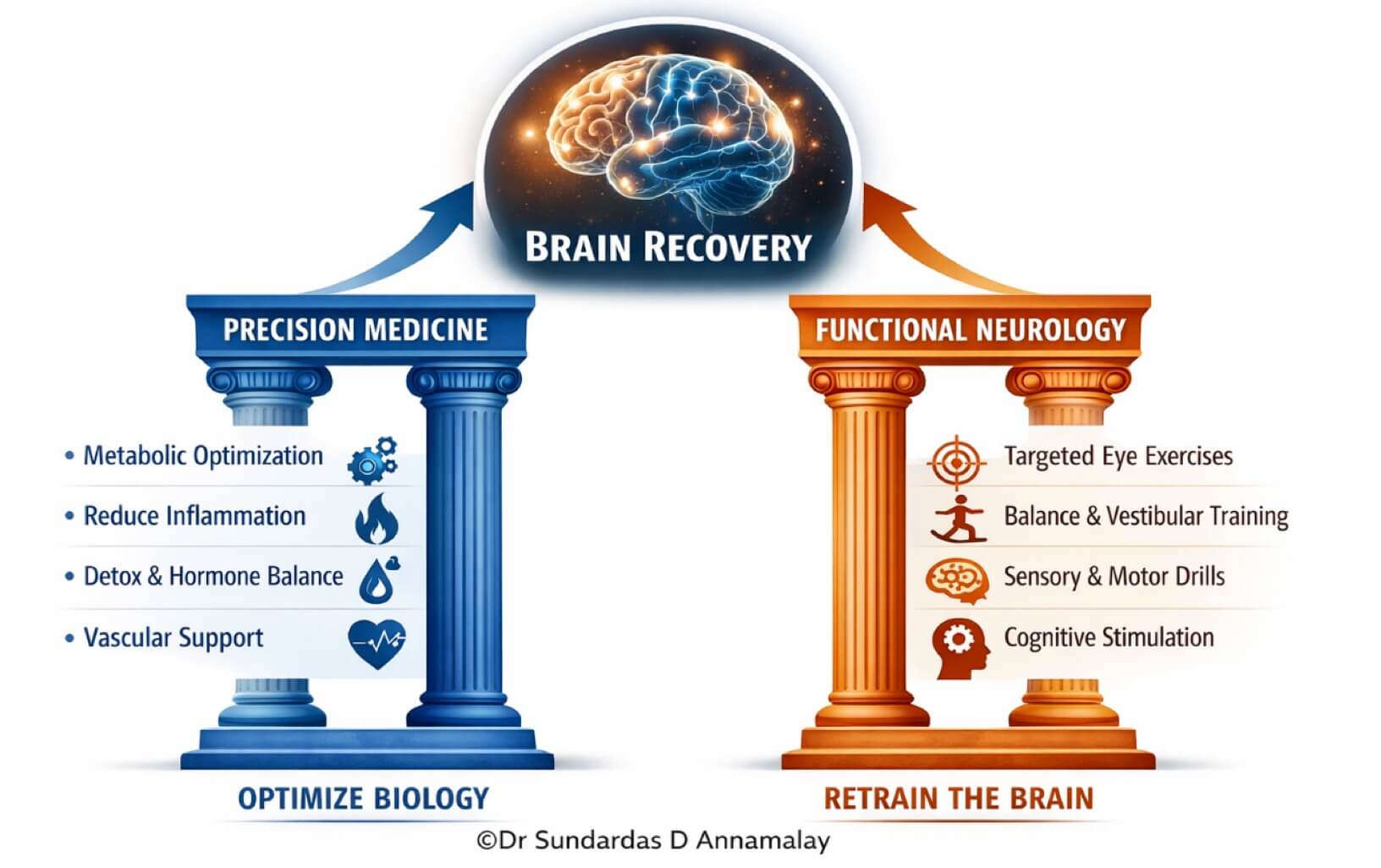
Precision medicine addresses these contributors methodically:
- Optimize glycemic control and metabolic flexibility
- Reduce systemic inflammation
- Correct nutrient deficiencies
- Support mitochondrial function
- Improve vascular integrity
- Address toxic or infectious burdens
- Restore hormonal balance when indicated
This creates a more favorable internal environment. It removes friction.
However, removing friction does not automatically restore performance.
If a neural network has been underactive for years, simply reducing inflammation will not instantly reestablish speed, coordination, or cognitive endurance. The brain requires targeted stimulation to reorganize and strengthen pathways. Neuroplasticity is use-dependent.
This is where functional neurology becomes central.
Functional neurology applies structured, task-specific stimulation to activate underperforming circuits. The goal is not generalized cognitive stimulation but precise input to specific networks.
Examples include:
- Targeted eye movement exercises to engage frontal eye fields and cerebellar circuits
- Balance and vestibular training to stimulate cerebellar and brainstem integration
- Sensory integration tasks to refine cortical processing
- Coordinated motor drills to enhance hemispheric communication
- Executive function challenges to strengthen prefrontal networks
These interventions are not arbitrary. They are selected based on examination findings that identify asymmetry or under-activation patterns. The stimulus must be specific enough to drive adaptive plastic change.
Precision medicine prepares the terrain. Functional neurology retrains the system.
Together, they create a bidirectional strategy:
- Reduce physiological stressors impairing neural performance.
- Deliver targeted activation to rebuild network efficiency.
This dual approach acknowledges an essential truth: biology and function are inseparable. You cannot rehabilitate a brain that remains metabolically inflamed. And you cannot expect biology alone to restore complex cognitive performance without deliberate retraining.
True recovery requires both an optimized internal environment and active neuroplastic engagement.
When upstream drivers are corrected and neural circuits are systematically stimulated, we do not merely slow decline. In many cases, we observe measurable improvements in clarity, processing speed, attention, and memory.
The brain is adaptive. But adaptation must be directed.
Recovery is not passive. It is constructed.
If you need help you can click HERE to review your lifestyle choices and find out what you can do to improve it.
Health and Wellness Assessment
We are here for you at Sundardas Naturopathic Clinic.
Yours in Health,

Prof Sundardas D Annamalay