
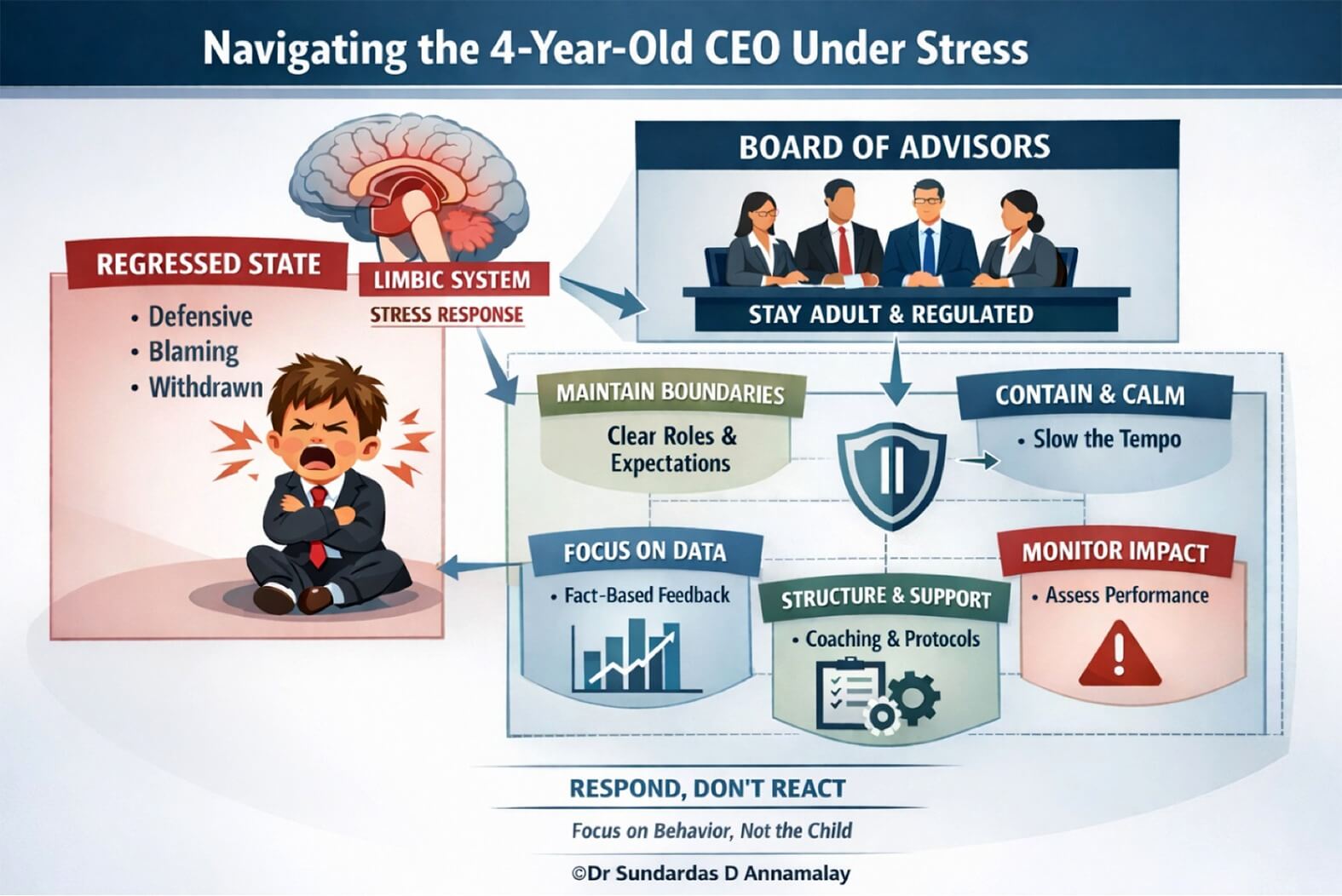
When a CEO “flips” into a four-year-old stress script, the board is no longer dealing with strategy. It is dealing with a nervous system in threat response.
That distinction is critical.
Early imprinting wires stimulus-response patterns long before language develops. Under sufficient stress, the prefrontal cortex (executive reasoning) downshifts and the limbic system (threat detection, attachment memory) takes the wheel. The behaviour that emerges—defensiveness, appeasing, blaming, withdrawing, grandiosity—is not random. It is patterned adaptation.
https://www.yourmindstrategy.com/LIVE/events/success-permission/
For a board, the risk is unconscious participation. The directors can easily slide into parental roles: rescuer, critic, enabler, disciplinarian. Once that happens, governance degrades into reenactment.
https://blog.drsundardas.com/why-people-experience-emotional-breakdowns/
Here is how a mature board navigates the minefield.
2. Separate the Person from the Pattern
The board must internally label what is happening:
“This is a stress response, not a character flaw.”
That framing prevents moralizing. It keeps the focus on observable behaviour and impact rather than personality judgment.
Directors should discuss behaviour in concrete terms:
“In the last two meetings, you redirected responsibility toward the team when performance data was challenged.”
Not: “You’re being defensive.”
Precision de-escalates shame.
2. Refuse the Surrogate Parent Role
Boards fail when they unconsciously become:
The critical father
The rescuing mother
The permissive aunt
The punitive authority
Instead, they must remain in role: fiduciaries.
That means:
- Calm tone
- Clear expectations
- Measurable outcomes
- No emotional escalation
The nervous system co-regulates. If the board stays regulated, it reduces the probability of further regression.
3. Shift from Confrontation to Containment
A dysregulated CEO cannot process complex feedback in the moment. The goal is not to win the exchange. It is to stabilize the system.
Techniques:
- Slow the tempo of the meeting
- Ask one question at a time
- Redirect to data
- Pause if tone escalates
Containment communicates safety without surrendering standards.
4. Build Structure, Not Surveillance
If regression under stress is predictable, then governance must reduce ambiguity.
Clarity lowers threat perception.
Examples:
- Predefined KPIs and decision rights
- Structured performance review cadence
- Agreed escalation protocols
Executive coaching as part of development, not punishment
Structure prevents emotional drift.
5.Normalize Development
A sophisticated board does not pathologize stress responses. It treats them as developmental edges.
A direct but non-shaming framing might be:
“Running this enterprise activates pressure patterns in anyone. Our role is to ensure you have the support and feedback to lead at your highest capacity.”
This invites growth without humiliation.
https://www.sundardasnaturopathy.com/emotional-healing
6. Know the Threshold
There is a line between temporary regression and chronic impairment. If repeated stress responses materially harm culture, performance, or ethical judgment—and the CEO cannot integrate feedback—then the board’s duty shifts from support to succession planning.
Compassion does not override fiduciary responsibility.
The deeper principle is this:
When the CEO becomes four, the board must remain adult.
Not cold. Not punitive. Not indulgent.
Adult.
Steady nervous systems. Clear boundaries. Measured language. Data-anchored feedback. Developmental support.
Early adaptations are intelligent survival strategies. But they were designed for childhood environments, not complex enterprises.
The board’s task is to create a container strong enough that the leader can outgrow the script—rather than reenact it at scale.
If you need help you can click HERE to review your lifestyle choices and find out what you can do to improve it.
Health and Wellness Assessment
We are here for you at Sundardas Naturopathic Clinic.
Yours in Health,

Prof Sundardas D Annamalay