
Some people can sense a change in another person’s mood before a word is spoken. This sensitivity may be described as empathy, intuition, or emotional intelligence. Yet when it is shaped by trauma, sensitivity can become constant monitoring.
A child living with unpredictability may learn to watch faces, footsteps, tone of voice, silence, and small shifts in behaviour. Detecting the adult’s mood becomes a way to anticipate danger. The child may try to prevent conflict by becoming pleasing, useful, invisible, or emotionally responsible for everyone in the room. https://www.yourmindstrategy.com/LIVE/events/success-permission/
Over time, the boundary between “what I feel” and “what you feel” becomes unclear. Another person’s disappointment feels like personal failure. Their anxiety becomes an emergency. Their anger creates immediate guilt. The person may believe it is their responsibility to calm, rescue, fix, or absorb the emotional state of others.
This is not the same as healthy empathy. Empathy recognises another person’s experience while remaining connected to the self. Emotional absorption takes the other person’s experience into the body and treats it as a personal obligation.
Porous emotional boundaries often lead to overgiving. The person says yes when they mean no, offers help before it is requested, and ignores their own fatigue. Resentment may build quietly because the care is not entirely voluntary. It is driven by fear of conflict, rejection, or being seen as selfish.
Boundary-setting can therefore activate a threat response. Saying no may produce racing thoughts, chest tightness, guilt, or an urgent desire to reverse the decision. The discomfort does not necessarily mean the boundary is wrong. It may mean the nervous system is encountering a new pattern.
https://www.sundardasnaturopathy.com/programs/emotional-healing-trauma-recovery
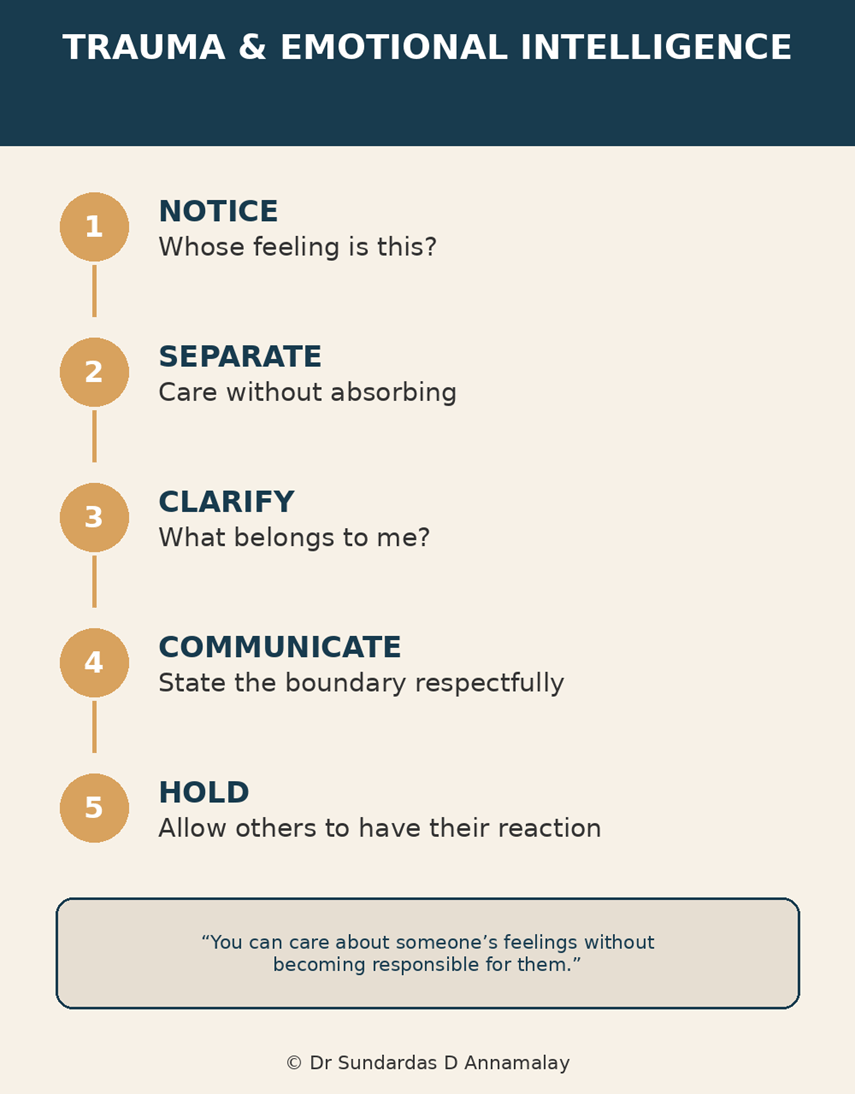
Emotional intelligence requires differentiation: the ability to understand that two people can have different feelings, needs, and responsibilities at the same time. Someone else can be disappointed, and you can still make a healthy choice. Someone can be angry, and you do not have to abandon yourself to make the anger disappear.
A useful question is, “What belongs to me here?” Your feelings, words, decisions, promises, and behaviour belong to you. Another adult’s reactions, assumptions, choices, and emotional regulation belong primarily to them. Compassion may influence how you respond, but compassion does not require taking ownership of what is not yours.
Boundaries are not walls. Walls prevent contact. Boundaries organise contact. They clarify where responsibility begins and ends, what is acceptable, and what conditions support safe connection.
Practising boundaries can begin with small, respectful statements: “I am not available tonight.” “I need time to think.” “I can listen for ten minutes, but I cannot solve this for you.” “I understand that you are upset, and my decision remains the same.”
The goal is not emotional detachment. It is connected presence. You can care deeply without becoming consumed. You can understand another person without agreeing. You can offer support without becoming their nervous system.
As emotional boundaries strengthen, empathy becomes more sustainable. Care is offered from choice rather than compulsion. Relationships become clearer because love is no longer confused with rescuing, compliance, or self-erasure.
Your sensitivity may be a gift, but it was never meant to make you responsible for every feeling around you. Healthy boundaries allow compassion and self-respect to exist together.
Reflective Practice
Pause and identify one recent situation in which your reaction felt stronger than the immediate event. Name the body sensation, the emotion, the older belief that may have been activated, and one response that would preserve both self-respect and connection.
https://www.sundardasnaturopathy.com/programs/neuroplasticity-cognitive-wellness
We are here for you at the Sundardas Naturopathic Clinic.
Click here to review your health patterns and identify practical priorities through a Health and Wellness Assessment: Health and Wellness Assessment
Prof Sundardas D Annamalay

Book a private consultation today and take control of your own health. Simply email us at admin@naturaltherapies.com to make an appointment, or call +65 63236652. We are pleased to offer consultations via Zoom for online coaching clients.