
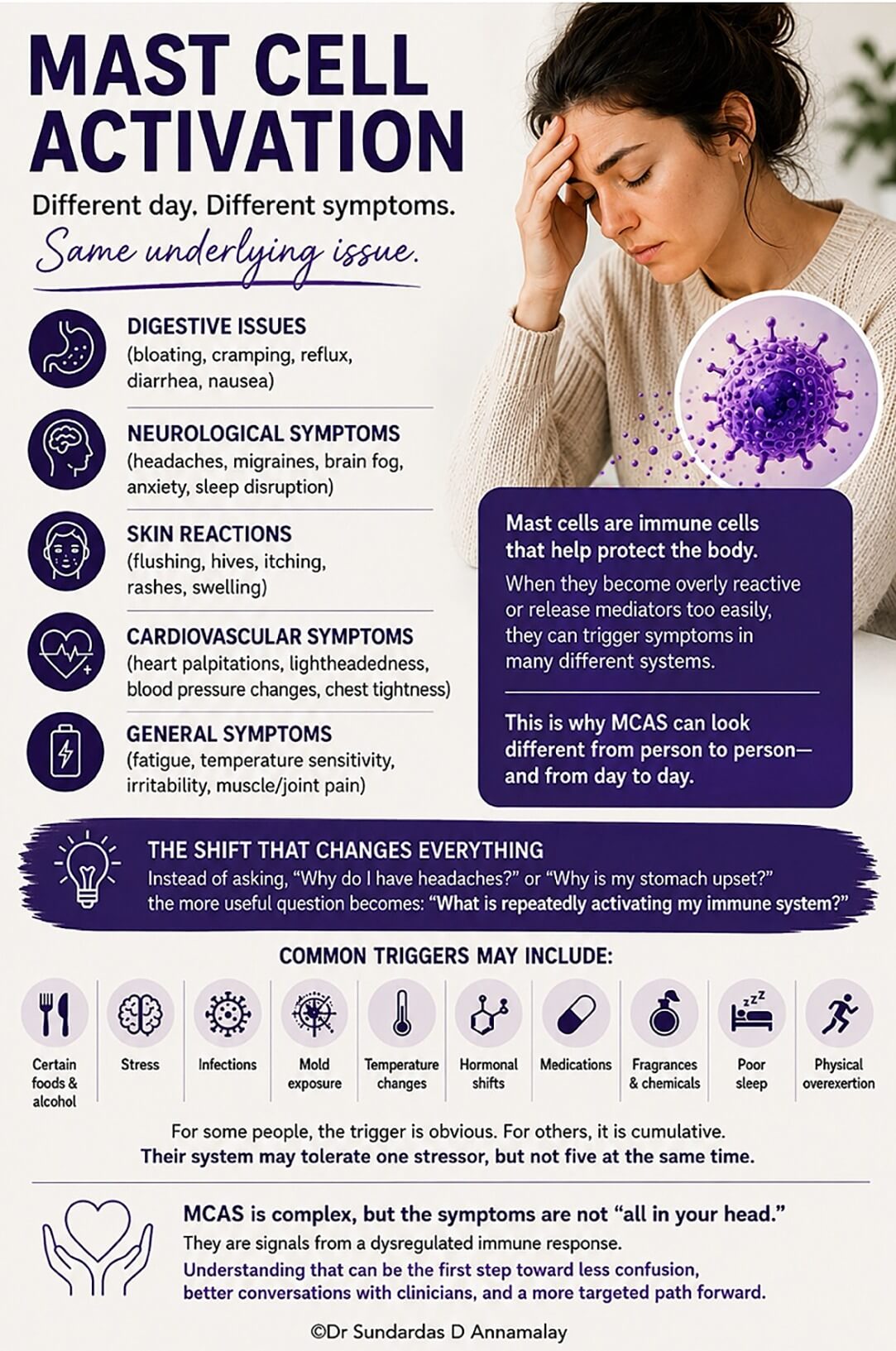
One day it is digestive issues.
Another day it is headaches.
Or flushing.
Or fatigue.
Or anxiety, skin irritation, brain fog, heart palpitations, and potentially more.
For many people living with Mast Cell Activation Syndrome, often called MCAS, the symptoms can feel random, inconsistent, and difficult to explain.
That is part of what makes the condition so frustrating.
A person may react to a food one week and tolerate it the next. They may feel fine in the morning, then suddenly develop flushing, nausea, itching, dizziness, or a racing heart later in the day. They may be told their labs are “normal,” even though their body clearly does not feel normal.
https://www.sundardasnaturopathy.com/digestivewellness
This can leave people feeling confused, dismissed, or as if they are chasing one unrelated problem after another.
But MCAS is not usually about one isolated symptom.
It is about a pattern.
Mast cells are immune cells that help protect the body. They are involved in allergic responses, inflammation, wound healing, and defence against infection. When they are appropriately activated, they release chemical messengers that help the body respond to a threat.
The problem occurs when mast cells become overly reactive or release these mediators too easily.
That release can affect many systems at once.
In the digestive tract, it may show up as bloating, cramping, reflux, diarrhea, constipation, nausea, or food sensitivity.
In the skin, it may appear as flushing, hives, itching, rashes, swelling, or sensitivity to heat and pressure.
In the nervous system, it may contribute to headaches, migraines, brain fog, sleep disruption, anxiety, irritability, or a wired-but-tired feeling.
In the cardiovascular system, it may feel like palpitations, lightheadedness, changes in blood pressure, chest tightness, or episodes that mimic panic.
This is why MCAS can look different from person to person.
It can also look different in the same person from day to day.
The symptoms often appear disconnected until someone begins looking at the immune system as a whole rather than treating each complaint as a separate issue.
That shift matters.
Instead of asking only, “Why do I have headaches?” or “Why is my stomach upset?” the more useful question becomes, “What is repeatedly activating my immune system?”
Common triggers may include certain foods, alcohol, stress, infections, mold exposure, temperature changes, hormonal shifts, medications, fragrances, environmental chemicals, poor sleep, and physical overexertion.
https://blog.drsundardas.com/is-your-fatty-liver-shortening-your-life-span/
For some people, the trigger is obvious.
For others, it is cumulative. Their system may tolerate one stressor, but not five at the same time.
This is why tracking patterns can be so valuable. Symptoms, foods, environments, stress levels, menstrual cycle timing, sleep, medications, and exposures may all provide clues.
MCAS is complex, but the symptoms are not “all in your head.”
They are signals from a dysregulated immune response.
Understanding that can be the first step toward less confusion, better conversations with clinicians, and a more targeted path forward.
If you need help you can click HERE to review your lifestyle choices and find out what you can do to improve it.
Health and Wellness Assessment
We are here for you at Sundardas Naturopathic Clinic.
Yours in Health,

Prof Sundardas D Annamalay